PERSEITY
art review
Essays
Reflections from a Dead End: Flora Yukhnovich’s Four Seasons at The Frick | by Eric Bayless-Hall | February 19, 2026
A Sense as Cold... | by Arnold Klein | February 9, 2026
The Consolation of Illustration: Dana Schutz | by Candice T. Seymour | January 17, 2026
Le Repas Frugal | by Emmet Elliott | January 6, 2026
Perception and the Essay of Criticism | by Eric Bayless-Hall | December 15, 2025
Alla Prima Amnesia: Phoebe Helander at P·P·O·W | by Anna Gregor | December 15, 2025
Homage To— | by Arnold Klein | December 15, 2025

PERSEITY
art review
Perseity (formerly, briefly, Ridge Art Review) is an art / criticism magazine founded on the conviction that individual artworks are the basic unit of meaning in art analysis, that perception is an activity and takes work, hence that writing criticism is its own creative work.

PERSEITY
art review
Reflections from a Dead End
Flora Yukhnovich’s Four Seasons at The Frick
February 19, 2026 | by Eric Bayless-Hall
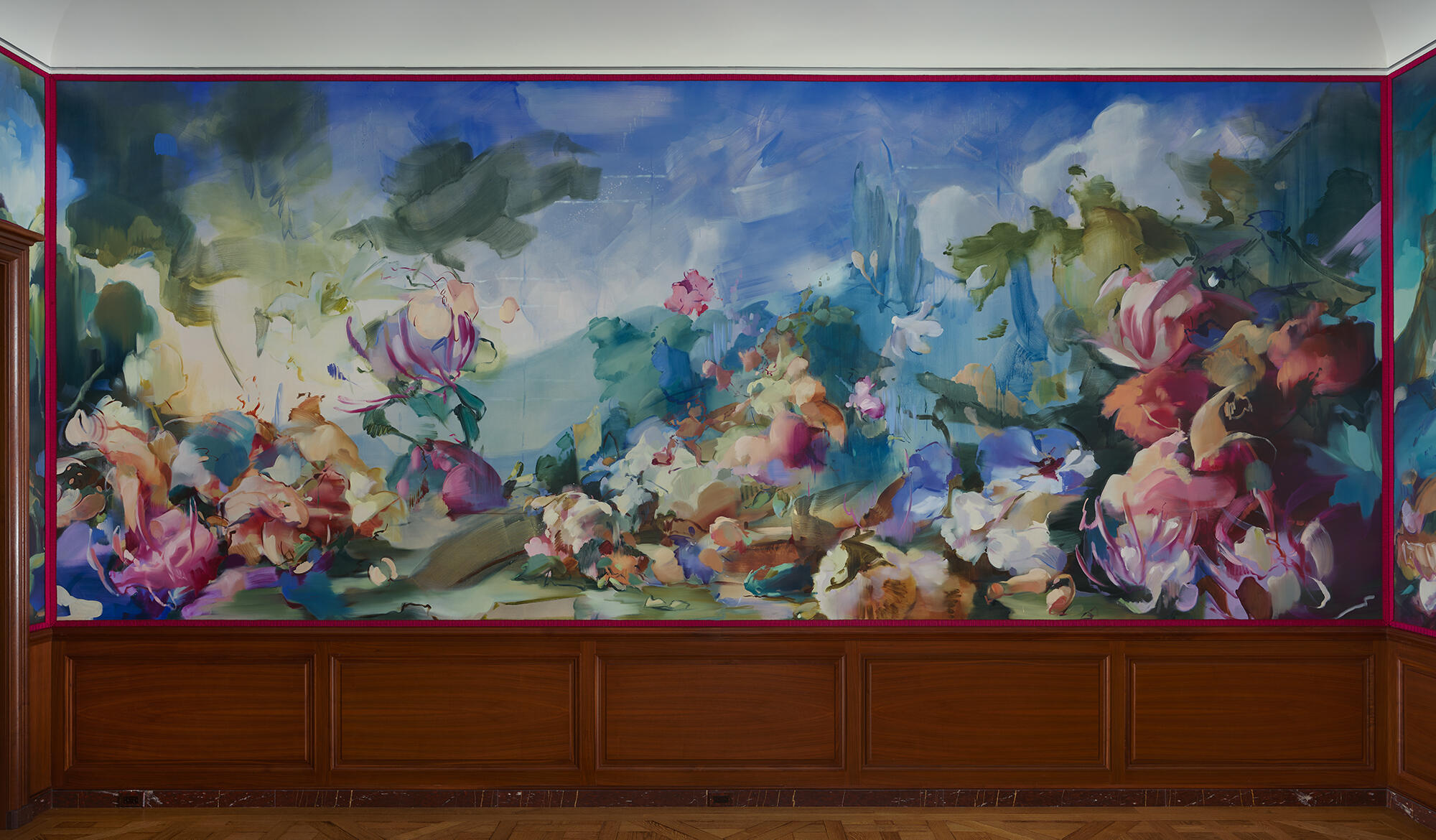
Flora Yukhnovich, The Four Seasons: Summer, 2025 © Flora Yukhnovich. Photo: Joseph Corsica Jr.
“How much finer things are in composition than alone. ’Tis wise in man to make cabinets.” – Emerson’s Journal, July 13, 1833.A cabinet is queer sort of thing, no?—a dead end in which we place and leave and later find things, whose grouping can appear at once accidental and, in flashes, overwhelmingly necessary. The making of cabinets I first took Emerson to be referring to was not that noble craft of woodwork but rather the arrangement of things within one—the making of as it were a mere cabinet into a cabinet, say, of curiosities, or of natural history, as the Cabinet of Natural History in Paris which occasioned the above quoted note, where he had seen gathered together so many organic and inorganic forms. His entry continues:
Here we are impressed with the inexhaustible riches of nature. The universe is a more amazing puzzle than ever as you glance along this bewildering series of animated forms,—the hazy butterflies, the carved shells, the birds, beasts, fishes, insects, snakes, and the upheaving principle of life everywhere incipient in the very rock aping organized form. Not a form so grotesque, so savage, nor so beautiful but is an expression of some property inherent in man the observer,—an occult relation between the very scorpions and man. I feel the centipede in me,—cayman, carp, eagle, and fox. I am moved by strange sympathies; I say continually “I will be a naturalist.”
The experience reported, I want to insist, is the discovery of the observer’s relation to his environment—to the things we call living and nonliving that one shares the world with—and that this discovery coincides with, or simply is, the discovery of order where mere amalgam seemed to be, an order—organization, formation, composition—which, importantly, includes the observer.—Not, in other words, an order we somehow impose onto variety, but an organization which composes us, our organism, and into which we will decompose.That this discovery takes place in a cabinet is worth dwelling on—that this encounter with (let’s call it) nature (one’s own and one’s environment’s) was arranged by human hands. This, I think, helps us to understand why “’tis wise in man to make cabinets.” We are wont, I think, to think of nature as expansive and ever-open, infinite and inexhaustible, something we might enter and be swallowed by—or else plunder and be rewarded by. But this is a strange picture if we, indeed, are animals and so are, quite literally, never—really—apart from nature. We forget that our view of it is always a view within it. But this means we, at least—we humans—are required to meet the world within human limits too, for these are animal limits. (And the denial of those limits coincides with the denial of it as our environment, what we turn within.) We can meet it, no doubt, outdoors, but not, as it were, outmind. Experience is sometimes pictured as a play on a stage of the mind;—here we can picture experience as the shifting contents of a cabinet: everything encountered coming in and going out of the room we inhabit. But then this is metaphorical, and Emerson seems literal: ’tis wise in man to make cabinets—as though we aren’t given enough in our experience, or don’t see enough of what’s given. And here I think we can hear him to say not merely ’tis wise to arrange things within a cabinet, but ’tis wise to make the cabinet itself: that making a space is a first step toward making an arrangement, and is the step that acknowledges our limits, which, rather than closing us in, reveals the obverse angles of nature’s surrounding presence. We might hear this as something of a naturalist’s justification, or rediscovery, of the indoors.And there are lines to follow out here on how and where nature and art touch.But I bring this all up in light of a cabinet no one wants to be in.Flora Yukhnovich’s Four Seasons fills four sides of The Frick’s Cabinet, formerly home to Boucher’s The Arts and Sciences. If you came into this cabinet, did a lap, and left—as all do, since no photographs are allowed and there’s no other way out—you might talk yourself into thinking there is meaning there. But, of course, you left, and don’t care to go back and find out.I think we are liable to confuse ourselves about what meaning is and isn’t, and so insist on it where it isn’t and deny it where it is. Part of this is no doubt owed to a genuine mystery. But I say baldly, but not blithely, that a work is meaningful which we want to keep attending to, turning and returning to. And this wanting is not a matter of words alone—of saying you want to—but of caring to and, opportunities availing, continuing to. The great works of art—the works that compose our personal canons (personal cabinets), that act as touchstones for the great—are those we are never done seeing or reading or hearing (etc.). (I take this to be definitional of a great work of art, not an accident to one.) So the promises that Four Seasons makes are promises to continue rewarding attention. Instead, however, and I say this without denying the pleasantness of its painterly moments, we find abundance covering over a deeper lack. Many forms will certainly take longer to see than fewer, but that doesn’t change the fact of their finitude, that once you see every inch of the canvas, you’ve seen all there is to see.But I’ve almost neglected to discuss the work. What’s promising in it? And what fails?On each wall is a landscape scene a la ’30s Disney™ backgrounds overlaid with an abundance of forms, some recognizable as flowers, fruits, trees, birds, beasts, and others suggestive of forms we aren’t quite able to identify—most, nevertheless, with a couple curious exceptions, suggestive of the organic: roundnesses, drips, pools, scratchy patches—suggestive, though we’re not always sure what of. Some of what is painted takes time to see. Amid so much information, discovering the few humanesque forms is not immediate. And, though I do not feel the centipede in me, this is promising. Why? Because there’s more than one thought was there—more to look at—and first impressions, though hard to shake, too often tell us more about ourselves than about the work. So we attend.
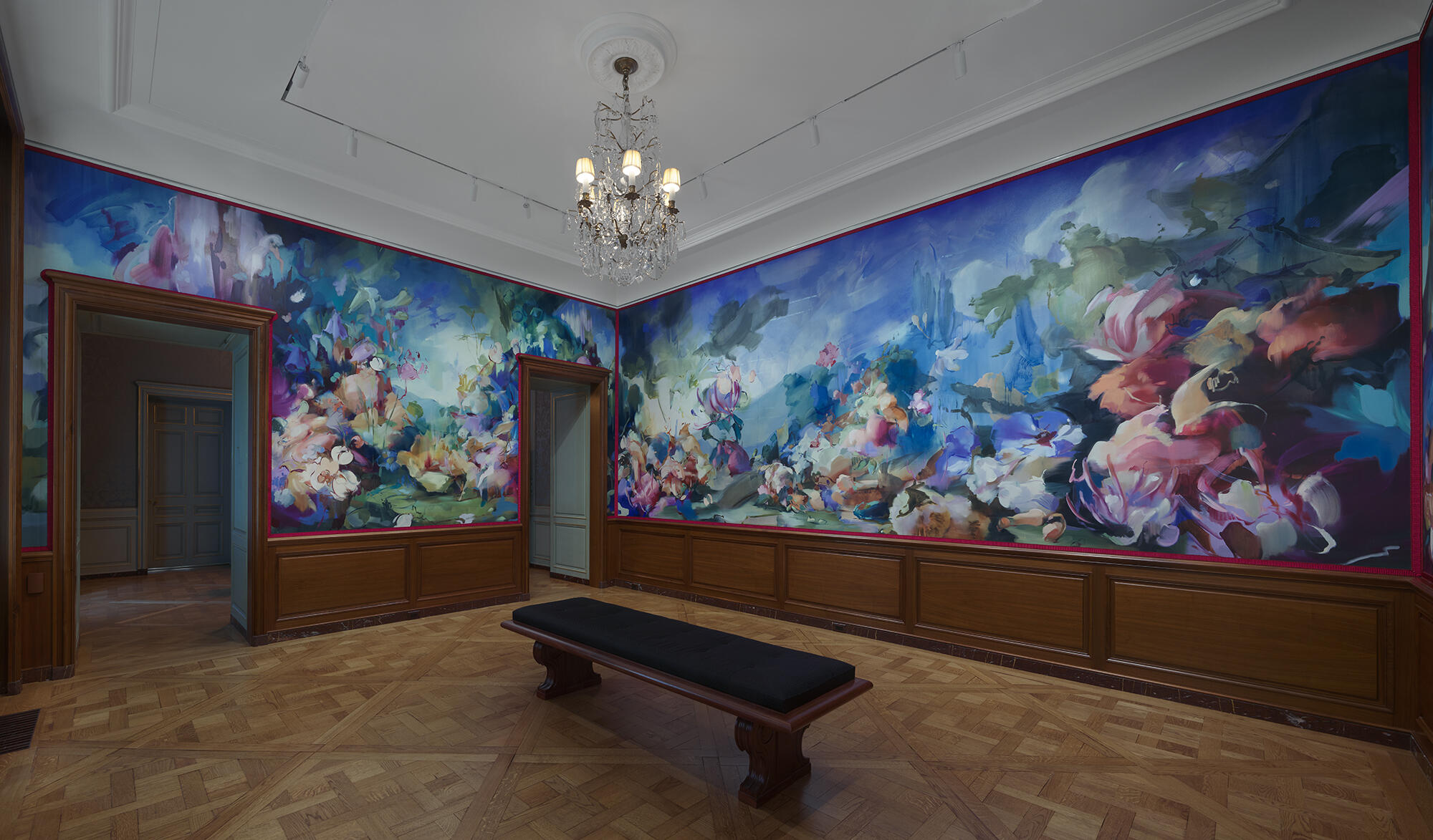
Four Seasons: Spring and Summer © Flora Yukhnovich. Photo: Joseph Corsica Jr.
The second promising step this work invites is to have us look at the paint. Yukhnovich is evidently skilled with the medium. A surprising variety of technique goes into the making of these forms and always in a way revealing of the strokes. This is presumably what is meant when the work is described as being “contemporary abstraction” (a phrase we’ll want to come back to): standing an arm’s distance from almost any stretch of canvas we find strokes growing out of one another, suggestive of organism, sometimes becoming full fledged flowers or deer.But where does this lead? What does it promise? First, that there is something to see. And that something, if this is to be more than a game of I Spy™, is not just anything, but something worth seeing. (The work is taken on trust when its worthiness isn’t immediate. Many of the best aren’t; so this is all promising, as far as it goes.) But though the painter has an eye and hand for the pleasing paint mark, this doesn’t reward looking any more (in fact, less) than the Snow White backgrounds they resemble (and even less than the Bouchers they vaguely ape).The most promising thought is that the outgrowth and interplay of forms in Four Seasons might become an image of the organic itself—that the abundance might not be abundance merely, that the discovery of forms in the thicket of shapes might be more than a game of recognition in a crowd, that the painter’s interest in paint’s suggestiveness might come to more than the sense—which by itself is not confirmed to be more than the hallucination—of meaning. You see, if all this painting has to offer is its abundance of stuff to look at, and that looking doesn’t coincide with any deepening or broadening of one’s sense of it, then we are to conclude that it is just a dead end to enter once. And at that point it is just a pretty wallpaper or background, to be grouped with the Edge observation deck, not the Frick’s masterpieces. At that point—though I never thought I’d say it—why not let people take pictures?But one’s disappointment is relevant to criticism only to the extent that it is explained by the work. So what is responsible for what I called this work’s deeper lack?
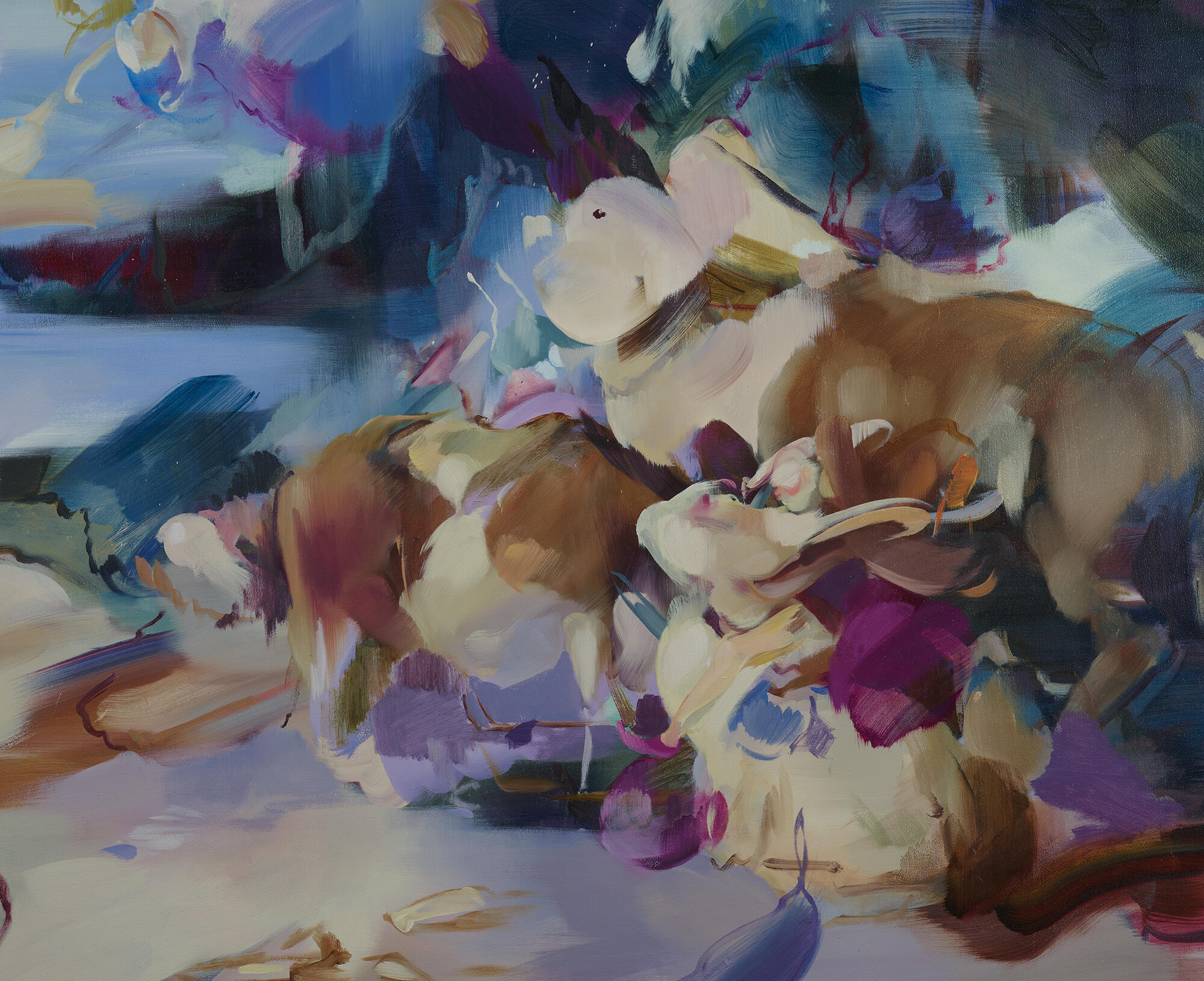
Four Seasons: Winter (Detail) © Flora Yukhnovich. Photo: Joseph Corsica Jr.
I find a clue in the painting’s human forms—humanoid is more appropriate, since they are rough and more of the Barbie™ than the animal kingdom—painted in ways similar to other figures, but consistently more sketchily and incompletely than other organic objects. At first this suggested the (promising) idea of humans as no larger part of this environment than peaches and pansies, which I hoped would lead to a thought of what an environment according to this painting is—and, seeing as it depicts (kind of) the four seasons and actually encloses you, this promised to bring several strands of observation together. (Hence I was led back to Emerson, and wished to stay there.) But this thought hits a dead end in the fact that these humans are fantastical: almost elvish creatures astride bunnies and moose-like beasts more at home in Narnia than Central Park. What promised—to my ears—to be a picture of the natural world that we are outgrowths of, proves on closer inspection to be heedless of reality.Parodying Johnson, the late William Aile said that it is easy to achieve the pleasurable once you have abandoned the real. We might add: and if the pleasurable starts to seem like a high bar, the fantastical is even easier. And lest I insult those who aim to express—as our time is in need of expressing—the fucky fact of fantasy in modern life, let me clarify the scope of my criticism. Four Seasons, if it has wished to reflect on fantastical forms as part of our environment, fails to begin to do so, for these elements are only inchoate. And if I’m right that what this painting wishes to express are possibilities of reality and the human organism in relation to its environment, then it fails to get there, and the swerve to the fantastical is a dodge. In an age characterized by the avoidance of reality, this seems like the better referent for the painting’s Contemporary Abstraction™, which starts to sound less like the press release noise it first seemed and more like a condemnation.Others might find more and better to criticize in Four Seasons, but it would require remaining longer in the room, which I venture to guess they won’t do.
About the Author:
Eric Bayless-Hall teaches and studies in New York. His writing appears in The Revenant Quarterly.

PERSEITY
art review
A Sense As Cold...
February 9, 2026, by Arnold Klein
The University of Chicago famously did away with its varsity sports programs in the 1920s; by the time I got there, however, a few of these had been restored (I was a three-letter man in one of them). In the interim, though, the students perfected a different competitive sport, one modeled for them with great skill by the faculty, namely, condescension—in which, I must admit, my record in the classroom, on the Quads, and around the coffee shops, about matched mine on the piste: 49-50.But that was only intramural. Outside the walls, in that great humbug, the world, one passed for a prodigy. One-upmanship belongs to that class of cruelties a philosopher has well-called “ordinary,” but the UC imparted a refinement of it that was distinctively its own. It consisted in the self-assurance that you knew everyone’s special intellectual business better than they themselves did; and what made the habitus hard to kick was that, more often than you might think, one did know it better—always did, when the business in question had anything to do with reading books, for twelve quarters of it left one pretty good at finding and following “the structure of the discourse” with an acuity, an assiduity, an accuracy, and always with an openness to the thinking and admiration for the thinker, that really did set one—I no longer say “above” everyone not so versed—but certainly apart from them: you often found yourself wondering what the devil people thought they were doing when they read anything serious.Now, the competition described above was a collegiate affair; it was part of the undergraduate ethos to regard graduate students as not worth bothering with, and as to professors—well, they were absolutely out of one’s league. One of my central teachers was a stylist in the Santayana mold, whose prose combined beauty and rigor; another was actually a master mind; the best was 6’6’’; and in general, one was glad to look up to the faculty, and took in good part their condescensional finesse, when they cared to display it, which some of them did pretty regularly, at least at me. But, for all that, I waive the rare opportunity offered, posthumously, as it were, by some of his writings, to condescend to a UC professor, eminent, and justly eminent, for learning and brains, and celebrated by his students for his scrupulous and effective teaching; one, moreover, with whose very-UChicago conception of liberal education I more or less completely agree. (The “less” part will clarify itself as we go along.) For those writings exemplify (among others things) what happens when a certain kind of prepossessions—in this case, ethical ones—meets a certain kind of objects—in what follows, a few dramatic poems—and by “what happens” I mean what is ignored, what is distorted to fit, what is lost, what is fobbed off and what is foisted on: a whole schedule of the malpractices consequent upon subsuming the individual under the general without sufficiently “minding the gap,” as they say on the London subways, between those two uses of the same article. This mode of—felonious subsumption, if I may be allowed to add yet another crime to the intellectual statute books— is by no means, as Gilson puts it, an error of small minds; indeed, the very self-confidence that great intelligence has in its own real superiority is a great source of it. And this, too, these writings exemplify, for the liability to such over-estimations (and to the underestimations these necessarily entail) is quite wide-spread, and I hope to characterize it a little more closely later on, and perhaps impart my personal name for it. But first the prepossessions.Our author’s position (or the part of it needed for what follows) is that human beings, who have bodies and souls, should, by way of giving each endowment its due, govern their instincts by reason, in the aspect of the virtues; that the selfish desire for glory, for example, when so governed, is changed into a worthy aspiration for nobility; that eros, though allowed to have a physical as well as a psychical reference, gains, in this way, wisdom for one of its proper objects; and that all these are not ideological prejudices relative to history or culture, but truths of human nature that apply everywhere and always.It is clear that this position is at odds with then-current, and I will add, still-current, American notions of freedom (as spontaneity), democracy (as egalitarian), relativism (cultural and/or historical) and sex (as at once casual and momentously important), and with ever-persisting romantic conceptions of love (as an acute exalted emotional state, valued for its own sake); clear, too, that an educational program inheres in it, in which the student’s own striving is directed, through the careful and rigorous reading of such materials as have proven themselves rewarding along these lines, toward real freedom, from, in the first instance, the cant of her time and place, and ultimately as wisdom and self-control. (This is more or less the “more” part of the “more or less” above.)Now, if the truths in question be transtemporal and transcultural—human, that is—it is natural that our professor should find the works of that great humanist, Shakespeare, in agreement with them; and here the descent from the universal to the idiosyncratic begins, and is, well, bungled. I will take only a few parts of our professor’s survey of a few plays to illustrate this.In Troilus and Cressida, says our professor, Shakespeare “suggests…that wisdom, austere and externally unattractive, is the one thing permanently available to man that is noble and choiceworthy.” “Suggests” covers a good deal of ground, and the play is heavily freighted with actual stupidities; “but for a few choice viewers,” Ulysses, alone among the characters, “represents” something like practical wisdom, and his action in the play—principally his “instructing” Achilles in nobility and subjecting Troilus to the “terrible torture” of watching Cressida vamp—“accomplishes” the exposure of heroic and romantic illusions, and “this” will “ultimately restores peace.”I will quarrel with “represents” as we go along; for the moment, observe how it universalizes the particular, and, to that extent, is a case of what Bentham calls “begging the question with a single word.” And I suspect what constitutes those “viewers” “few” and “choice” is their sharing with Ulysses the vocation of instructing and torturing the virile young for their own good. But, as to the play at hand, is any of this stuff about Ulysses actually, I do not say “true,” but right? Does the subsumption in question, of Ulysses under “unattractive sapience,” actually consist with the exact wording of the lines that actually create that specific speaker and situate him in this play?In the course of what our professor calls his “earnest but sophomoric love talk” in the opening scene, the “love-moody” Troilus particulates Cressida:
Her eyes, her hair, her cheek, her gait, her voice;
O…
In so doing, he multiplies words (all those “hers”); and since he indicates that Pandarus has already said all this (“This thou tell’st me/As true thou tell’st me”) multiplies them not only by particulation, but by frank repetition.He has done this earlier in the scene, in his second set of lines, polyptotonically, with strong, strength, skillful, skill, fierce, and fierceness, and in his following duet with Pandarus (I say “duet” because our prof says that P “is a character reminiscent of Viennese light opera”—one who bequeaths his audience his diseases, be it noted), in which Pandarus particulates a cake in terms of the operations needed to make it, in the course of which account he repeats grinding, bolting and leavening, ay, to, must and, of course tarry, with Troilus joining in at each point with his repeated have I not tarried and still have I tarried, the last term notable for calling attention to the delay that talking in this way effects.So it is not “love-moodiness” in general, whatever that is, that Troilus generically instances, but a very specific set of locutions whose significance he does not knowingly intend, and which his interlocutor reproduces unawares, but which the playwright—who, after all, had something in mind in constructing and patterning the speeches in just this way, which only this way accomplishes—unerringly produced; and the question is, does the wise Ulysses join in this way of talking?Of course he does: the play would fail its own particular unity if he did not.Our professor understands the shrewd rhetorical strategy that informs Ulysses’ famous “speech on degree” (many professors do not), but the specific manner in which the speech continues the earlier “love talk” and cake-baking are left out of his account:
The heavens themselves, the planets, and this centre
Observe degree, priority, and place,
Insisture, course, proportion, season, form,
Office, and custom, in all line of order... ...What plagues, and what portents, what mutiny,
What raging of the sea, shaking of the earth,
Commotion in the winds, frights, changes, horrors,
Divert and crack, rend and deracinate…
Repetition-cum-particulation de luxe, and I’m leaving some out. And here’s two formulations that are pretty much tropologically equivalent to “love-moodiness”:
Then everything include itself in power,
Power into will, will into appetite,
And appetite... ...The general’s disdained
By him one step below, he by the next,
That next by him beneath; so every step...
As to delay, Ulysses himself calls his degree-speech “a tale of length,” and sums it up in eight words. Agamemnon then asks point-blank for his remedy, and Ulysses responds, not with the remedy (which, for all we ever find out, he may not even have), but with a detailed description of Achilles & Co’s shenanigans before being interrupted by the meaningless blaring of the tucket that precedes the arrival of Aeneas, who shows that the Trojans are no less particulative, repetitious and retardative than the Greeks—one of the many ways in which the two antagonists are shown to be the same, and their death-struggle, pointless:
...But peace, Aeneas;
Peace, Troyan; lay thy finger on thy lips...
Whereupon Agamemnon asks him “call you yourself Aeneas?” Which is one of the best jokes ever.Now, Aeneas is brought on at just this point so that Ulysses never gets to get to the remedy of which his previous 200 or so lines are presumably a preamble: the Ajax-device is prompted by Aeneas’s (lengthily delivered) challenge. In other words, the promised remedy is never given, though all the rhetorical steps to it are, and at length—just as Pandarus’s cake is never eaten, and Troilus’s resolve to unarm, the explanation of which is the subject of his whole duet in I.i, is never acted on. So to particulation and the rest we can add null-effect: all the talking has been for nothing, Ulysses’ no less than Pandarus’s. And—lest we forget—the plot to use Ajax to incite Achilles proves “not worth a blackberry,” despite what our prof calls Ulysses’ “shrewd management” of it; indeed, it backfires completely: and if the Greeks do “draw together” in Act V, it is no thanks to it, or him: Ajax and Achilles get off their butts for fortuitous personal reasons alone; and although it may be generally true, as our prof reminds us, that the policies of able politicians can fail due to the “limitations of men,” the specific question here is, why make Ulysses’ come so deflatedly a cropper. And while we’re at it, though “peace” may be “ultimately” restored in some fictional sequel, this play ends with Troilus voicing his “hope of revenge.”Ulysses says of Cressida:
There’s language in her eye, her cheek, her lip;
Nay, her foot speaks. Her wanton spirits look out
At every joint and motive of her body.
O...
The professor calls this speech “moralistic,” takes it, that is, in isolation from Troilus’s “sophomoric” love talk (which repeats, be it recalled, the light-operatic Pandarus’s), with which its particulative syntax plainly links it. The two adjectives in inverted commas belong to a subclass of question-beggars which, having discovered it, I hereby arrogate to myself the right to name: prerogative-adjective abuse.I could go on, but this is not an essay on this great poem. Before leaving it, though, observe that our professor omits the whole feasting business, which is so crucial to the play: for unless all the warriors on both sides meet face-to-face at some point, as they do here, the joke about their not recognizing each other on the battlefield, armored up and de-humanized as they all eagerly are (“Wilt though not, beast, abide?”), couldn’t get played. I call it a joke, because I am in on it, not because it lacks high moral seriousness.For high moral seriousness Troilus and Cressida does have; but if it is to be, what the professor seems to wish, a factor in moral paideia, it must be as it really exists, with all its inflections, weirdnesses, idiosyncrasies and plurivocalities, as these are expressed through all the resources of poetic drama, right down to those two post-particulative O’s that link the “love-moody” Troilus to the “dog-fox” Ulysses.But before we get to how such an apprehension may be an even greater moral factor, a few more examples of how our prof’s insistence on seeing specific characters as “representative” of universal human liabilities simplifies and, well—given the apex-level of the things he’s dealing with—levels down the complexity of his chosen plays.In The Merchant of Venice, he tells us, Shakespeare is “interested...in man’s attempt to become man and man alone,” a humanistic interest if there ever was one. “He was of the conviction that…when confronted with one another” directly, different principles “must necessarily quarrel.” OK; but on the way from this generality, our professor says that Antonio, whose Christian “sympathy cannot extend to a man who denies the fundamental principle of charity” (which would sort of make him unChristian), has “spit on Shylock.” But that isn’t quite so; Shylock does not say Antonio has spit on him. What he actually says is that Antonio has spit “upon my Jewish gabardine,” and that makes a very big difference.Clothes determine persons in the play, and as they change, so do the persons. Portia and Nerissa “turn to men,” and Portia to a “doctor of Rome” by borrowing “garments” of Doctor Bellario; Launcelot goes from serving “the very devil incarnation” to serving one who has “the grace of God” by virtue of his changing liveries; Solario’s imaginary ship, “my wealthy Andrew” (which becomes a “her” in the next line), may “enrobe the roaring waters with my silks—
and, in a word, but even now worth this,
And now worth nothing?
I’ll stop there; but notice that the changes of identity involved with clothes in just these three instances pertain to gender, titles, profession, social status, hometown, economic standing, religion (“I am a Jew if I serve the Jew any longer”), and—“in a word”—words (“You call me misbeliever, cutthroat dog”…“and say there is much kindness in the Jew”). Oh, and let’s not forget Jessica, who, by dressing up as a boy, is “transformèd,” and becomes a Christian, a quarrel-free conversion she regards as a change of “manners,” which, whatever they may be, don’t seem much like our professor’s “principles.” No wonder, with all these markers of identity depending on outward show, that no one in the play knows who is what when they can’t see them, either because they’re actually blind, like Old Gobbo, who is in the play just to show that, or temporarily unseeing, as are Jessica and Lorenzo, at night—L: “Ho! who’s within?” J: “Who are you?”—until a torch is lit. Little candles really do throw their beams pretty far in this “naughty world,” where a few drowned silks instantly reduce your worth from “this” to “nothing.”So whatever Shakespeare is “interested in” in this play acquires a very complex coloration, even from these few passages; indeed, a single right question—right because specific—to wit, “why the gabardine?”—lets us begin to see one of his interests very clearly, for in The Merchant, as in Troilus (“Have you any eyes, do you know what a man is?”), outward aspect, or “attribute,” is impermanent: there are no stable statuses. So one question, I do not say all, but a substantial subset of the plays of our poet (of whose life, thank God, so little is known that it relieves me of having to argue that by his name we are postulating an aesthetic physiognomy, not referring to an empirical person) is interested in, is what, if anything, is left of humans—of “man and man alone”—when all the changeful determinants are stripped off.Well, in a naughty world—a world of naught, as Auden rightly construes it—you’d expect the answer to be, well, naught; that is, nothing. But that answer, too, needs some inflecting.The question in question is raised in its epistemological aspect in The Winter’s Tale, as what is certain. No one agrees on anything in this play, and when they do, it is only for the playwright’s purpose of proving them wrong, mistaken, or deceived. I don’t want to go through the innumerable instances of certainty being ascribed—to eyes, ears, noses, hands, the oracle (the two envoys who hear its voice are “ear-deafened” by it, and it’s a priest, not a god, who hands them the envelope)—only to be retracted (“bare eyes” by “the pin and web,” etc.); I want to go a different way, which touches more on our bungling prof’s procedures.Now, The Winter’s Tale leaves the question of Hermione quite uncertain; but, either way, if she is guilty of adultery with Polixenes or not, there is a whiff of incest in the air. If she is actually guilty, and Polixenes is Perdita’s father, then Perdita and her intended Florizel are half-siblings. If Hermione is actually guiltless, then Leontes is Perdita’s father, and his suddenly leching vocally after the girl when he first sees her is simply incestuous. Our professor buys the “ear-deafened,” the-envelope-please-and-the-winner-is line—he finds Hermione “an unusually attractive, frank, intelligent, and open woman” (my itals, his “unusually”)—and explains the lech as “a gentle and ironic presentation of the perpetual Oedipus question.” But those strangely inapposite prerogative adjectives aside, the specific question is, why the lech in the first place? Why make incest an issue either way Hermione’s business is settled, only to squelch one possibility of its coming to fruition (but not the will to it) after two lines? The lech has nothing to do with the action or the characterization of Leontes. So why is it in this play?Well, consider how little the bear who eats Antigonus is concerned that the human whose shoulder-bone he has just torn off is, as the man himself is at pains to proclaim with his dying breath, “a nobleman.” And consider how indifferently nature propagates “bastard” flowers, and “betters” herself in so doing, according to Polixenes anyway, who is, however, so attached to pedigree as to disown his son, “a scepter’s heir,” if he marries “a sheep-hook” (doubly fatuous, if Perdita is his—though blue-bloods have never been averse to a little inbreeding). Humans care about status and blood lines; nature does not. All “great creating nature” seems to care about is, well, creating greatly; and as far as that goes, humans may as well be as promiscuous as squashes, who are notoriously given to heterozygosis.Now, epistemologically speaking, natural, on-going fecundity is the one thing in The Winter’s Tale constant enough to be verily known. Accordingly, the one thing everyone agrees on is the beauty of a fifteen-year-old girl’s fruiting body; and that is the only value our subset of plays finally arrives at. (Other plays that pose the question are Antony and Cleopatra, Timon of Athens, and Coriolanus.) If, as Santayana says, “nature can never be man’s ideal,” then Shakespeare is no idealist. Nor is it likely that a poet whose ultimate value turns out to be one of the few things humans have in common with our frenemies the fungi (who, indeed, rank us, sporulation-wise) is the “inventor” of “the human” that a different, not-nearly-so deservedly eminent, Professor Bloom proclaims him to be. Our own professor defines nihilism as “a chaos of the instincts or passions...The soul becomes a repertory company that changes plays regularly—sometimes a tragedy, sometimes a comedy, one day love, another day politics...now cosmopolitanism, and again rooted loyalty...” and I would not, by these lights, so designate Shakespeare. Buu-ut...now “worth this,” then “now worth nothing,” then again “worth this”? Now girl, now boy, then girl? Now bosom-buddies, now enemies, now machetenim? Now nobleman, now dinner, now fertilizer? Well, if I don’t call that nihilistic, exactly, it’s because I want to call it nihiline, a word I just read somewhere, if I haven’t just made it up, and want to use, rightly or wrongly, for the pleasure of it. Nihiline.Well, that was fun, but the point of this excursion has been that this prof’s treatment of some particular dramatic poems exemplified the catastrophe that befalls generalizers when they come down, with a thud, on the singular, in our case, when the generalizer begins from what he takes to be, and may even really be, the permanently moral, and subsumes under its categories the particularities of particular plays, without bothering to ask for the particular reasons those particular plays have for those particularities—why those two “O”s, that gabardine, that split second of Oedipal disinhibition. His philosophical bêtes noires are relativists, specifically historicists; but the same catastrophe afflicts this school of generalizers too, who, from their broad characterization of a temporally- and/or locally-defined context of some notional sort or other, venture upon the intrinsically unique; for whether it be in time or in eternity that either set their traps, the general will catch, in isolation from all the actually relevant others, only those particulars as are, or are imagined to be, or may not even be, or may not even remotely be, amenable to the terms of their chosen generalizations. And the same fallacy is called on by each school to justify the procedure: that the individual in question “represents” whatever generality they have it in mind to belabor.Now, this gross misconduct is especially flagrant when the fish being fried are particular works of art, each of which is intrinsically integral, and unified on principles uniquely its own, and represents nothing but itself. But I said that our particular professor’s procedure exemplifies a wider intellectual liability, whose ill consequences are, let us say, a good deal more momentous. To characterize his method a little more closely, it seems to be something like deduction: it starts with abstract truths and deduces from them the categories and concepts under which all particulars are presumptively considered subsumable. And, as far as reasoning goes, his conclusions may well follow from his premises and be, to that extent, what logicians call “valid.” But, as we said, at a certain point there is a hiatus in the series—the point at which we cease dealing in general properties and propositions and come to what Cardinal Newman calls “concrete matter.” Ratiocination here requires more than intellection alone to save it from becoming unreal; it requires what his Eminence calls “the illative sense;” and whatever “illative” means here, it is the sense part that is relevant to the hiatus in question.“Sense” is hard to define, and in art-cases, particularly so; the possession of it manifests itself in particular judgements of individual things, which must be as infinitely various as the things themselves; but one word Newman uses that is practically an alternative designation for it is tact—not the knowledge of, but the fingertip-feeling for, when, where and if general conclusions, however well-grounded in logic or experience, are to be applied, modified, inflected, or just plain dropped; and this touch our professor’s treatment of his subjects completely lacks: indeed, he could not have chosen a wronger poet for his ministrations than he did. To complete the quote which has given me my title, he comes to Shakespeare with a sense as cold
As is a dead man’s nose.
Now, Newman tells us that a person who possesses this sense in one field may lack it in all others, and it would seem that recognizing one’s own limitations in this regard requires a sense of the very same kind, which likewise might be lacking. When it is, and great intelligence fails to mind the gap between its deductions and individual cases, you get that peculiar combination of brain power and unreality I mentioned at the outset, that I have taken to calling the higher stupidity. You find it in literary critics, whose profound apprehension of Aristotle’s four-causal Poetics leads them to foist “plots” onto lyric poems; in Assistant Secretaries of State who are sure they know, and can control, what will happen in a country after they invade it and depose its regime; in economists who think that, economic rationality being eternally what it is, young people have children as a hedge against the high fees they anticipate paying for elder care sixty-five years hence—But I won’t call the role of all the University of Chicago departments chargeable under this rubric. It would seem that the fundamental problem in all such cases is one of direction: instead of descending to particulars, such brainiacs might try staying by them long enough to make sure their hot-air gasbags are fully full before wafting off into the intense inane. But the particular-up direction may be bungled, too. In the case of art works, the problem is that any collocation of particulars must preserve the integrity of each individual, whole and entire—an integrity that makes them each, in the first and last analysis, to begin and end with, actually incomparable. What constitutes tact in such an operation is a feel for which works, when placed side-by-side, may so mutually inflect each other’s actual incomparability as to increase and refine our acquaintance with it just as in itself it actually is. Whether the subset of Shakespeare plays I floated above, starting as it did from some peculiarities of Troilus and Cressida, displays such tact or not, it at least remained cognizant of its own heuristic character.But, of course, there is nothing in starting with particulars that requires going anywhere but to other particulars. The refusal of generality—of collocality, even—may strike moral absolutists and cultural relativists as irresponsible, but even my nihiline grouping is not without its moral significance, for nihilism, too, is a moral attitude, and it is well, especially paideia-istically speaking, to see it so nuance-laden-ly worked out. (We have come full-on to the “less” part of the “more or less” we started with.) But more: appreciating the thing before us, just as in itself it really is, is a taking on of responsibility for one’s relation to it, not a dodging of it. Another word for this act is attention, which, a philosopher tells us, is itself a moral act, indeed, the moral act, from which any action that is truly regardful must begin. And the open spirit that welcomes all such plural uniquenesses just as they are, and preserves them from being reprobated, faulted, dismissed, blended, pureed, liquified or, worse yet, impressed into the service of a generalized dogmatics of any ilk, was still truly abroad at UC when I was a student there, at least in the departments I hung around in.
About the Author:
Arnold Klein's work appears regularly in The Revenant Quarterly.

PERSEITY
art review
The Consolation of Illustration
Dana Schutz’s Console at The Metropolitan Museum of Art
January 18, 2026 | by Candice T. Seymour
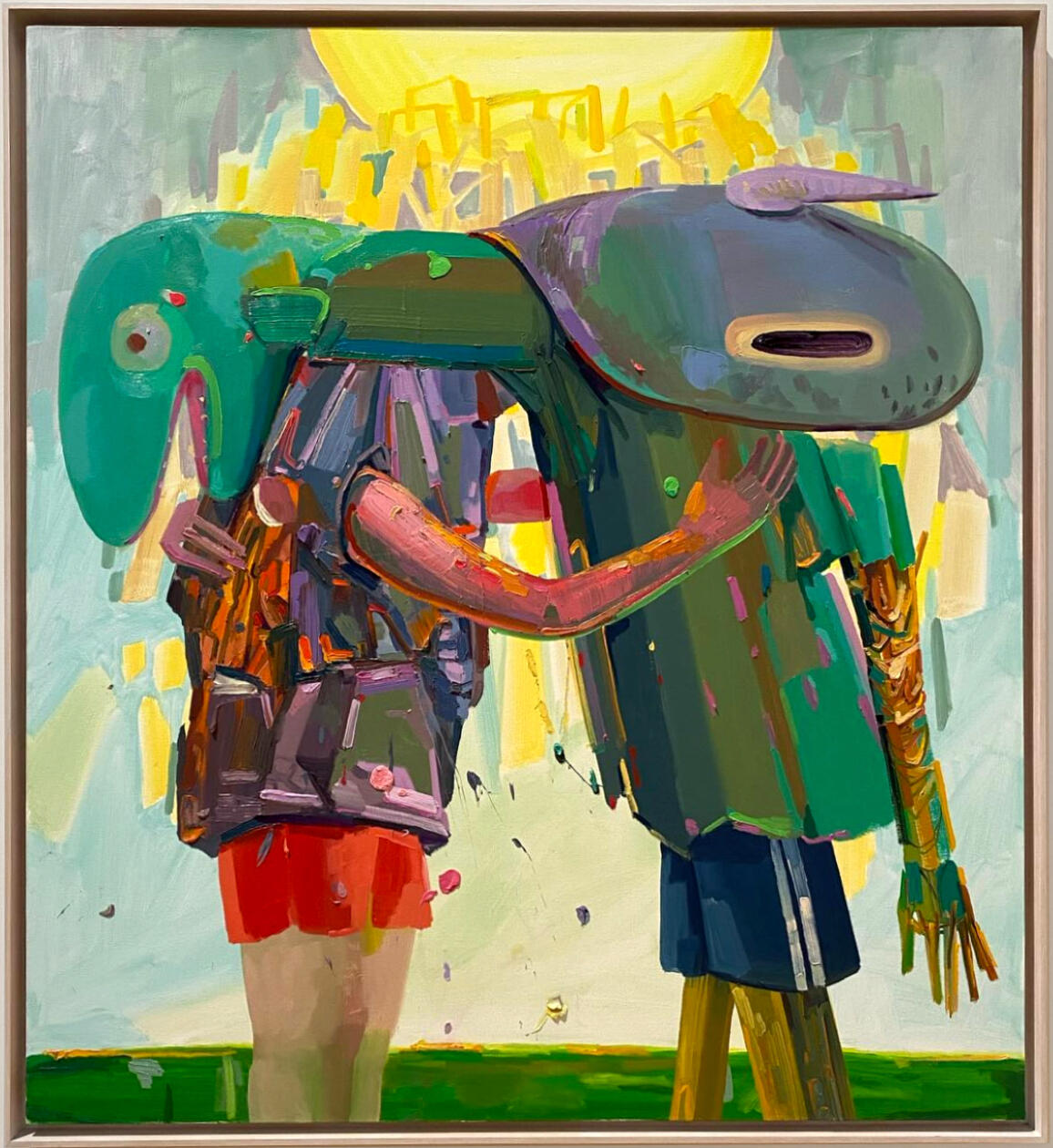
Dana Schutz, Console, 2003. Oil paint on canvas, 66 × 60 inches.
Painters sure seem to love Dana Schutz. Allegedly she’s a painter’s painter. Whatever that means. If Schutz’s Console is a painter’s painter’s painting, the epithet must not mean much. With a color scheme like that of a children’s television series, the mid-sized painting shows two composite figures, one with the head of a cartoon-like dinosaur and the other a cyclopic half-human, forming a compositional chiasmus as they embrace. Their mismatched parts—more or less human or artificial, natural or prosthetic—suggest wear and tear, and repair: limbs ripped off, subsequent surgeries performed without requisite replacement parts. The plasticky quality of the oil paint recalls children’s toys and the unmixed impastos that visually stack to compose the hybrid figures suggest the piecemeal constructions of Tinker Toys or Lincoln Logs. It is tempting to imagine that through this hug the two figures are supporting each other, engaging, perhaps, in another exchange of parts, as their chiasmic configuration and the title suggests.Yet this narrative of deformation and reformation is merely suggested (its substance recalled, imagined) by a viewer who, disappointed by the painting, tries to grasp why the Metropolitan Museum of Art would give it a wall in its contemporary wing (thereby claiming it to be an exemplar of 21st century art). The painting’s form—its specific relation of parts to whole, visually and conceptually—lacks the composition, decomposition, and recomposition of material and image necessary to realize such a narrative. Or if you, like me, suspect that no paintings are, nor possibly could be, narrative, but, rather, must (to be art at all) embody what it is they are of; that is, to realize a painted world in which two creatures of artifice have their given bodies destroyed and repaired piecemeal, the painting itself (its givens and its body) would have to undergo a process of destruction and reconstruction analogous to that of its depicted toy-like subjects.But the painting is made without play, despite its cartoon-y style, and without struggle, despite the amputations and repairs that its Frankenstein figures seem to have undergone. The confusion of which body part belongs to whom is only superficial: overlapping bodies, a contaminating brushstroke crossing one color scheme into the other. The few dollops of paint, suggestions of the play in painting, the accidents that lead to discoveries, function more like stickers: one imagines them carefully applied to the canvas after it was finished, like cherries on top of a sundae. The thin yellow-and-blue background reads as a way of filling space quickly and merely, a rote solution with no significant relation to the figures. Ultimately, the painting is superficial, like the figures it represents. But unlike them, it has not been torn apart and rebuilt. Its body remains safely intact, if empty: decorated with pretty colors and kind-of-nice brushstrokes. If it had taken its own world seriously (embodying instead of illustrating), it might have risked decomposition, attaining life by cannibalizing itself. But it stopped short, content with mere suggestion. Perhaps to be a painter’s painter is to play it safe, believing that a predetermined composition, a premixed palette from an undergrad color theory lesson, and some controlled impastos are enough. Painter’s painters would be, then, those would-be painters who never develop beyond the level of the art student (in the narrow sense of performing rote actions within specified limitations; not the sense in which all real artists must remain students). If that’s the case, a painter’s painter (at least according to this painting by Schutz) isn’t a painter at all, but an illustrator of painting, who, consoling herself with what she already knows, ignores the moment when a painting demands to become itself by tearing itself apart.
About the Author:
Candice T. Seymour loves good artworks, suspects most artists don’t actually care about art, and hates nihilistic “critics”. Her essays have been published in Caesura.
Substack

PERSEITY
art review
Le Repas Frugal
January 6, 2026 | by Emmet Elliott
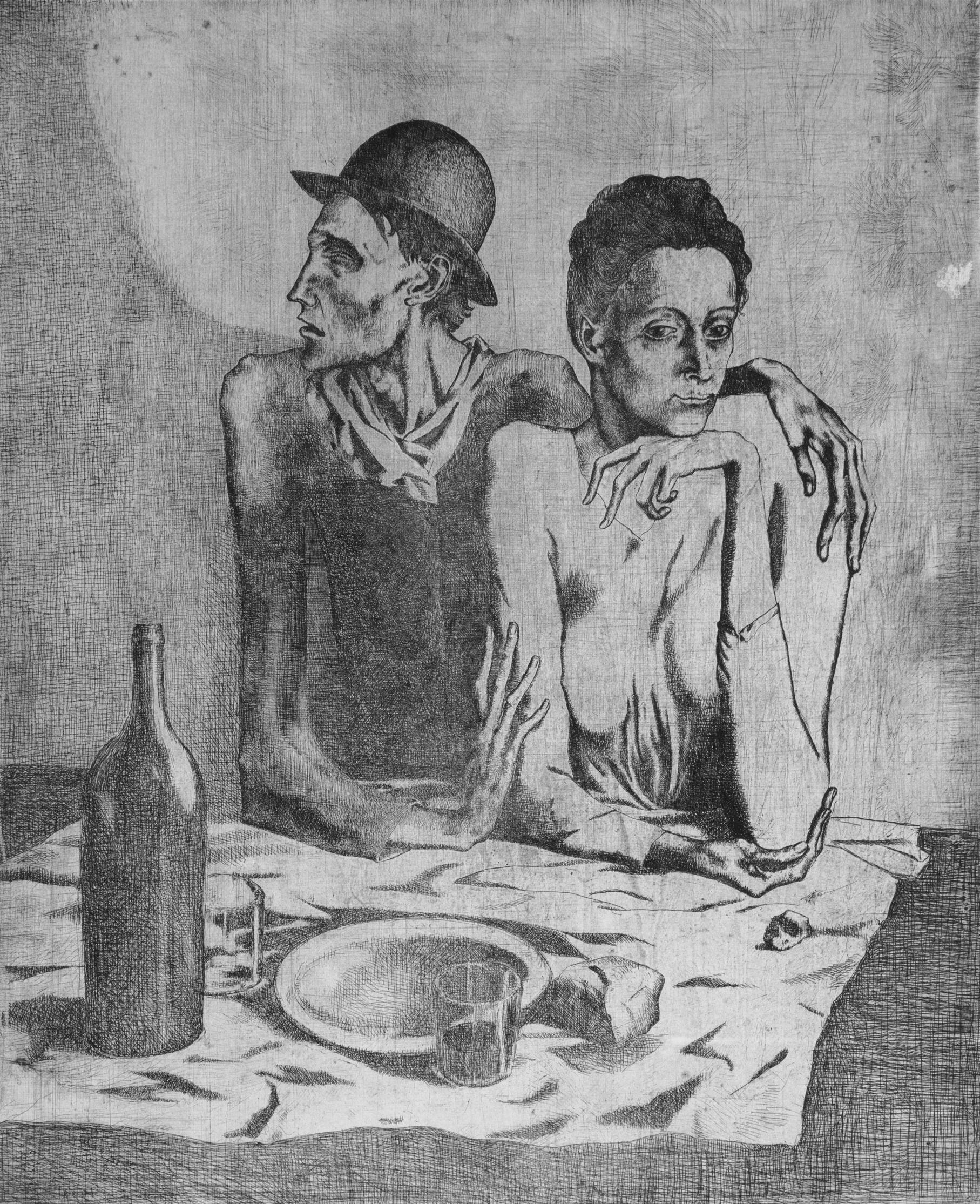
Pablo Picasso, Le Repas Frugal, 1904, printed 1913. Etching, 25 11/16 x 19 11/16 inches (sheet), 18 1/4 x 14 7/8 inches (plate).
The plate has been polished clean. The bottle has been almost emptied. In this etching, completed by a 22 year-old Pablo Picasso in 1904—his second print ever—we find a terrifyingly hungry young man.The plate itself was inherited from another artist, and would have had to be polished before etching could begin. If the faint thicket above the woman’s head is any indication, Picasso was eager to put this stage of the process behind him. The traces of bushes, as well as of grass and stones along the left, show us that the plate had been a landscape before Picasso turned it 90 degrees, and into the haunting portrait of an impoverished couple.Yet it is not simply a portrait. Picasso also borrows another genre from his tutor Cézanne—the still-life—to amplify poverty by foregrounding what is not there: more bread, for example, food on the plate, or knife and spoon. The plate looks to have been wiped clean, probably by the missing half of bread, and eaten with the hands. But whose hands? Maybe only one of them is ravenous. After all, her face is rendered with prominent cheekbones, yes, but it is not, as his, emaciated. There is still bread in front of her, her glass is half full, and perhaps most notably, her mouth is not open, not searching for the next morsel, but pursed. No, they are not hungry—he is hungry.But why should we associate the man who would go on to become the most prolific artist of the 20th century with the man in the etching? Is it because of his left hand, which emerges floatingly to the right of his companion’s face, drawing her into mid-air with impossibly long, articulate fingers (her left shoulder will be the final stroke)? Is it because the man seems to be missing his eyes? Because his eyes cannot be shown looking to the left of the frame while at the same time looking at the whole of the frame, gazing from the same position as ours? Does their absence from the picture—all the more conspicuous for their contrast with her vacant stare—call attention to their presence in front of it? And is it because we have seen Les Demoiselles d’Avignon, done only three years later, and know that the theme of the gaze, of looking at women with a jarring eroticism, would come to be a central aspect of Picasso’s work?Perhaps. But just as Demoiselles, this piece escapes simple reductions. There is just too much to see: the mysterious shadow behind the man which echoes the soon-to-be-empty bottle; the tablecloth (or is it paper?), which could almost be a cubist painting from ten years in the future, and repeats itself around and rhymes with the man’s neck; the subtle (and not so subtle) allusions to death, catholicism and even the printing process itself: an ink bottle, plate, and sponge all placed on a sheet of white paper. We can see Picasso musing on poverty, on death, on drunkenness, on printmaking and maybe even on what lays ahead of him… but the violence of desire, as much as we might wish otherwise, is as unavoidable for us as it was for him. Picasso keeps bringing us back to those four hands—which build an echo of the etching plate at its center—and what they frame. They frame the object of a young man’s desires, the source of his insatiable hunger in the stark black and white of ink on paper.
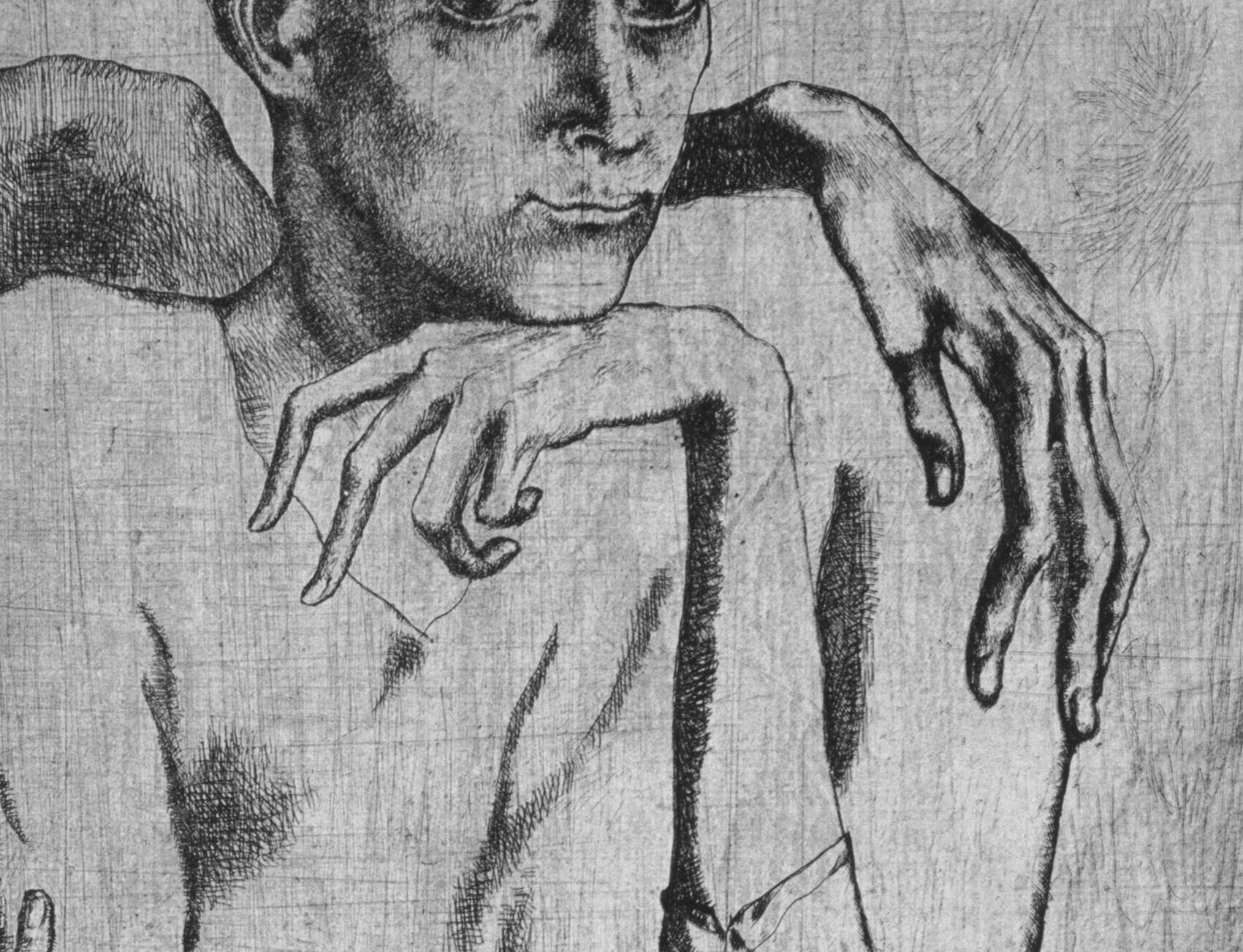
Pablo Picasso, Le Repas Frugal, detail.
About the Author:
Emmet Elliott studies, practices, and writes about architecture, urbanism, and the visual arts.

PERSEITY
art review
Perception and the Essay of Criticism
December 15, 2025 | by Eric Bayless-Hall
Dewey was right about one thing, at least. Seeing (or hearing, etc.) a work of art one is not merely passive. Just as the artist’s work wasn’t pure activity, but was, instead, punctuated by periods of seeing what’s just been done, so the viewer is not merely receiving the work in front of her, but engaged in actively recreating it: coming to see the connections between points or marks or themes or thoughts that the work of art is made of. We don’t need to buy a philosopher’s first principles and last conclusions to borrow the wisdom that washes up between them. And ordinary Dewey is wiser than most—enough to see a distinction worth making for all your gold: recognition is not perception.Forget, for once and for a while, your pet theory of recognition, and consider the sense this makes: we recognize what we know well enough for a purpose; whereas we begin to perceive when we haven’t yet finished learning what we’re looking at.Recognition is, on this view, a toolbox of types by which we fit a manifold world into familiar forms—classify quickly threats and objects of desire and the means to avoid and pursue them. We recognize, roughly, the things we have easy words for—this or that as this or that sort of thing; a pear, a panther, a painting, Paul Newman. However we came to see the world in the first place, the fact is, we find ourselves here, having started, and our seeing of things is always and irreducibly a seeing-cum-understanding—that is, we recognize more or less when we look. But the miracle of perception is—and it is, indeed, a miracle, for it seems, not only unexplained, but unexplainable without begging the question—that looking with attention actually discovers more than it originally recognized. That we recognize the world is remarkable; that it continues to reveal itself to attention is more remarkable still. This discovery of what’s in front of you by means of attention is what Dewey calls perception, and that it takes the form of modifying what we first thought we saw is what he means in saying recognition, though it is not yet perception, is the beginning of perception.Perceiving is a name for the work of seeing something unique, something that cannot be classed without sacrificing something of its distinctive character. Looking—really looking—which is as much an activity of the mind as the eye—reveals, remarkable as it continues to sound, this thing we’re attending to to be more and often other than we thought at first blush. Our initial recognition is developed, by an activity involving language as originally as color, into a more intimate familiarity with this particular thing. The more one looks, the more peculiar the thing under inspection becomes; and the more peculiarities one comes to find definitive of what this thing is, the more one will insist on the insufficiency of what we’re calling recognition: that you have to see, really see it.Whatever else we come to view as particulars—people, for instance, and the things we love—works of art can almost be defined as those human products whose particularity we insist on in our meaningful dealings with one another. Recognition doesn’t begin to account for our interest in them; nothing said about a work will be relevant until it springs from (what we’re calling here) perception.With these notions in hand it should be needless to say that the critic of art ought to perceive the work they write about—really see it. It will be equally obvious, however, that much of what passes for criticism is but the rehearsal of what is recognized. Critics, if there are any, are hardly more insightful on the whole than the tourist eager to announce before his tour guide tells him that that, in fact, is a Rothko they’re approaching. If you’ve had one Rothko pointed out to you, you can recognize them all as belonging to this type; but this patron, like the critic who associates in front of a painting without discovering these connections in the work under consideration, exhibits the perceptive powers of the man who catcalls legs from his car. What has actually been seen?And why is anyone supposed to care? Why write—and why read—art criticism that doesn’t do the work, first, of seeing what it’s pointing to, and second, of communicating it coherently? Here I’ll just report a hypothesis I’ve harbored for some time and say: serious looking will express itself in serious writing. My proof? The pudding. Try conveying a perception (in our sense here) in easy words and see if you don’t find yourself walking a thin ridge between the stodgy and the inane. Slipping into either you will know yourself to betray the sense you hope to express. If perception requires work, then this goes doubly for the writing of what’s perceived. One wonders how critics, supposedly devoted to the power of art, forget when they face the page that they face a form of the same problem as the artist.Now these two requirements, as I see them, for a critic—that they work really to see what they criticize and that they work really to write it—grow out of the basic nature of the undertaking: writing about works one’s encountered; and says about this undertaking only: strive to do it well or not at all. It should not be taken to deny, however, that writing about art well can take many forms, nor that critics, like artists, like humans, fall short on occasion. It is to say, rather, that criticism is to be an essay of one’s sense: an attempt to convey the reality one perceives as one perceives it, and this will involve criticizing oneself and one’s sense as much as the work one’s work is about.
About the Author:
Eric Bayless-Hall teaches and studies in New York. His writing appears in The Revenant Quarterly.

PERSEITY
art review
Alla Prima Amnesia
Phoebe Helander’s Paintings from the Orange Room at P·P·O·W
December 15, 2025 | by Anna Gregor
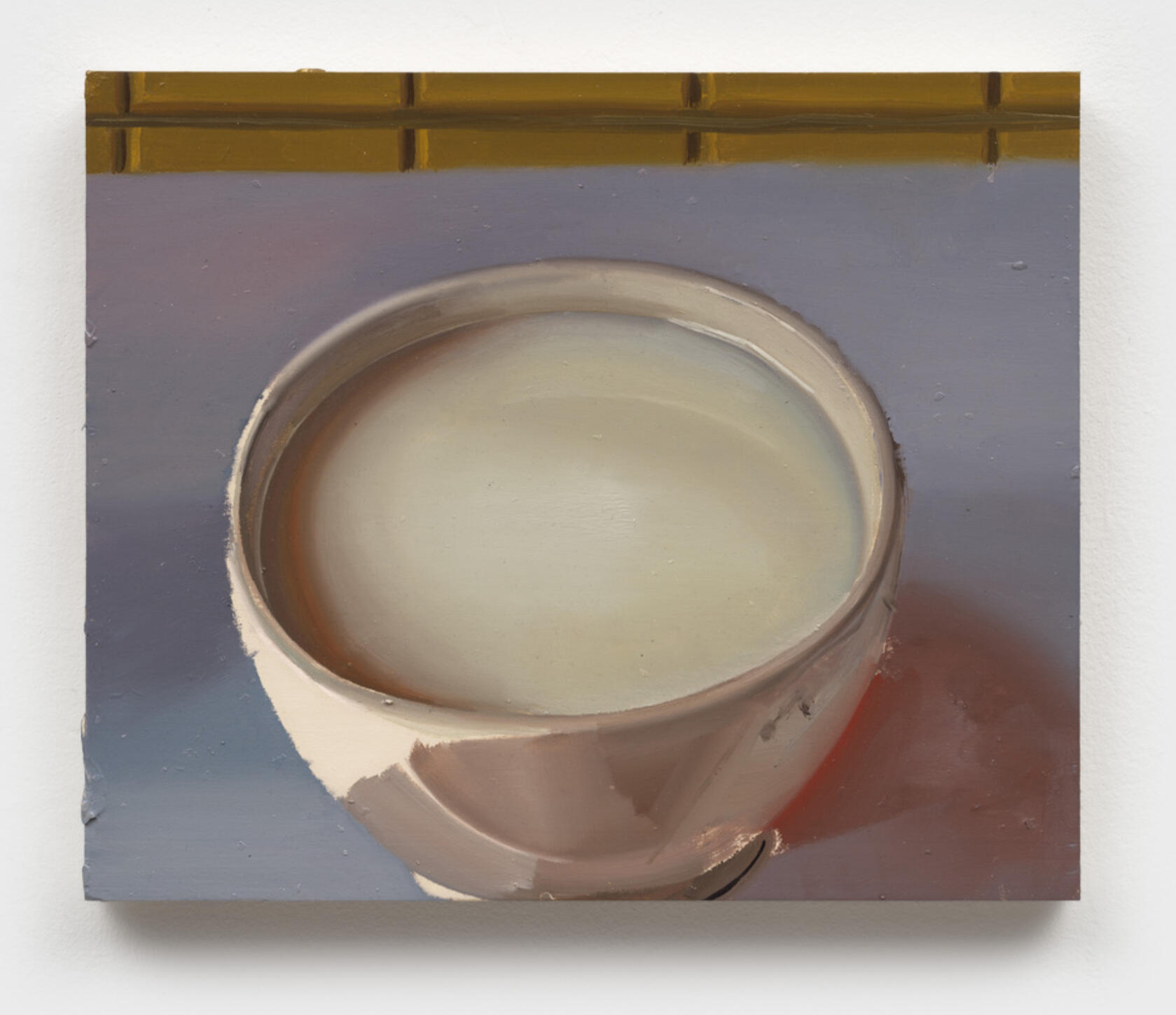
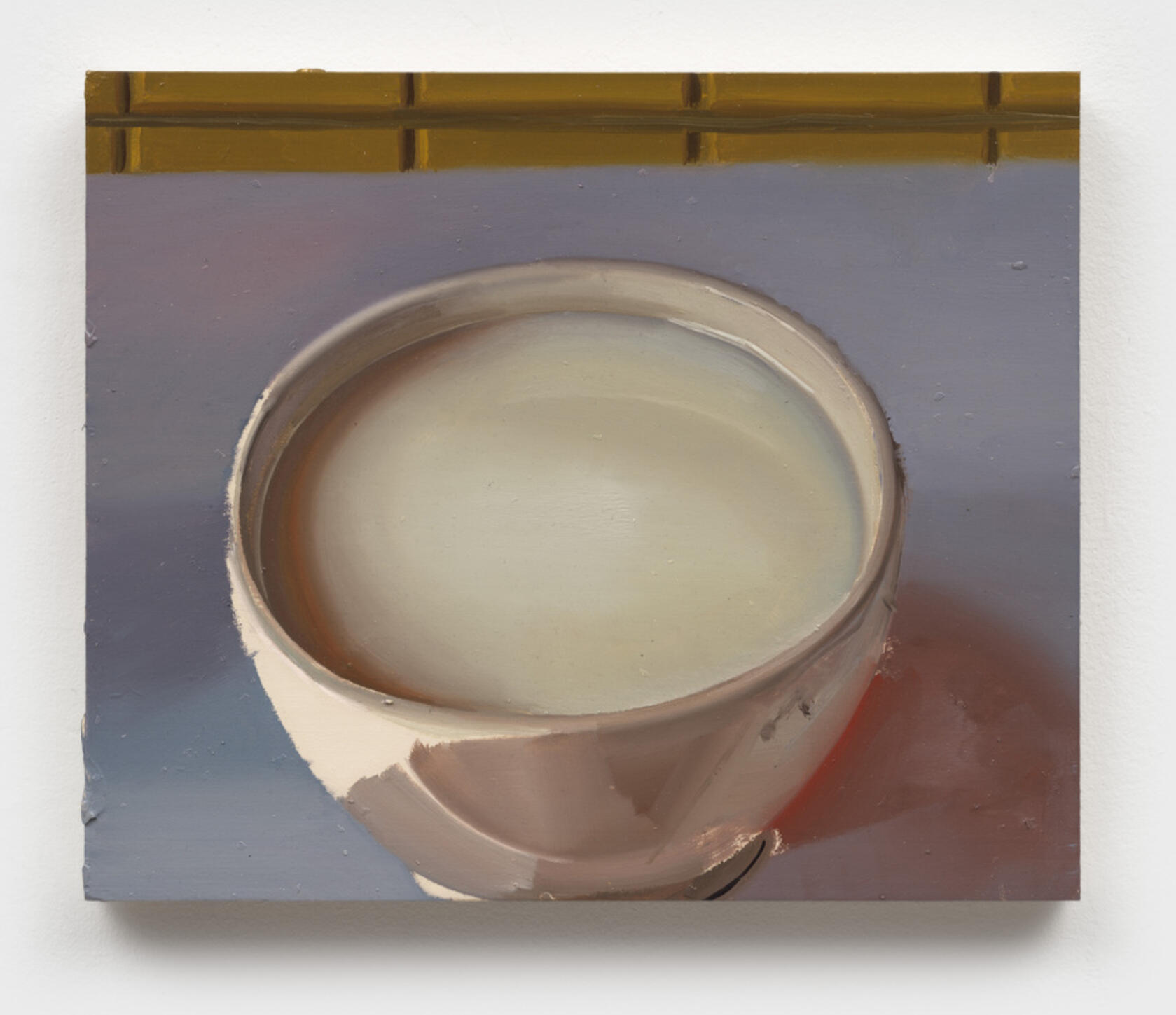
Phoebe Helander, Bowl of Milk III, 2025. Oil on wood, 11 1/4 × 13 1/2 inches.
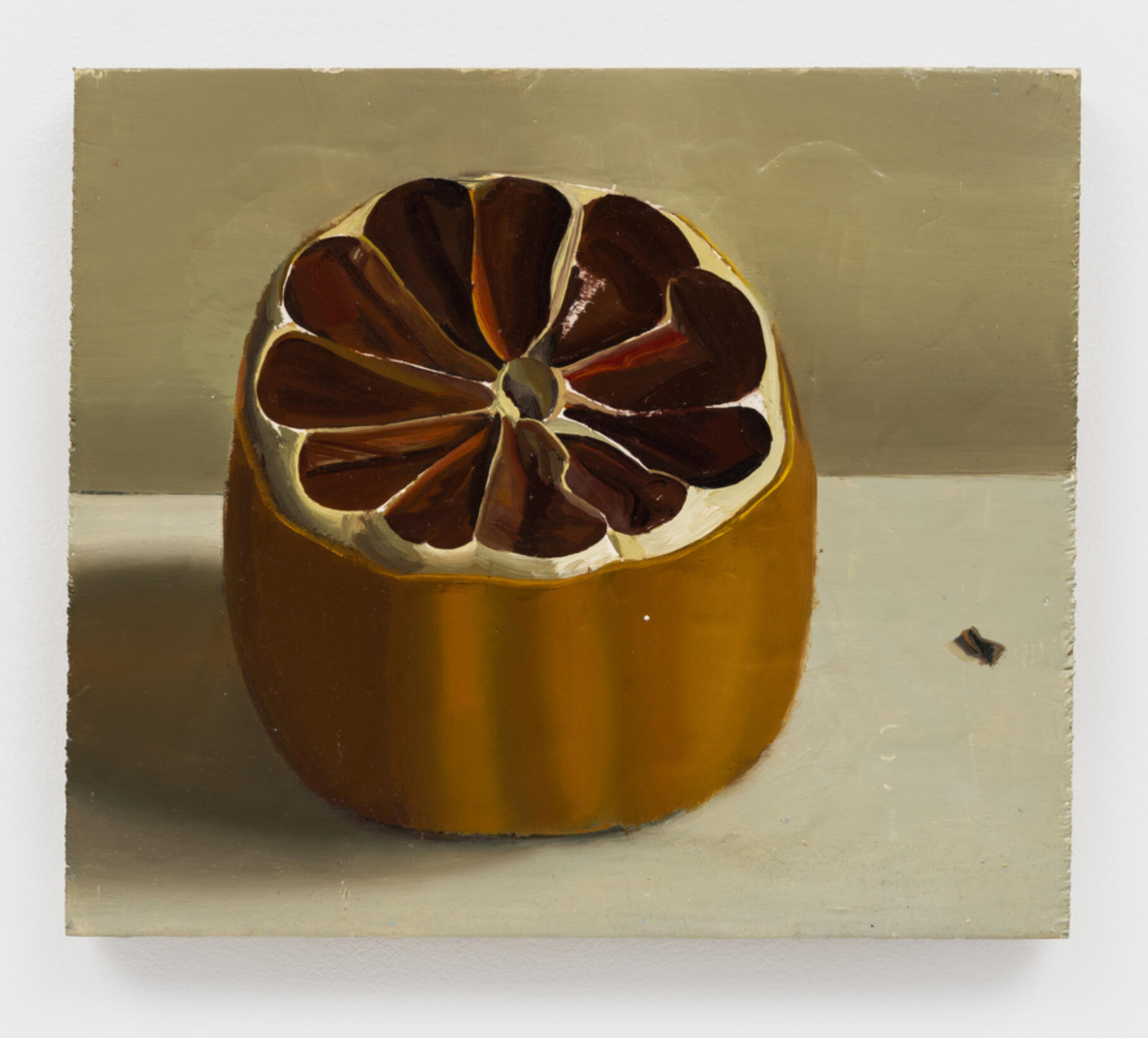
There must be over fifty paintings in Phoebe Helander’s Paintings from the Orange Room at P·P·O·W. All are still lifes, approximately head-sized. Most are painted on uncradled slabs of wood, some of which have already begun to warp or split. The panels appear to be prepared hastily and en masse, their edges splintered and striped with drips of gesso.The paintings are nice, even refreshing, compared to the other painting shows on view in the area. The lack of preciousness evident in the panel preparation contrasts with the careful representations of familiar still-life objects while accentuating the materiality of the painted images. In the best of the paintings, material support, brushstroke, and represented object correspond, synthesizing present and re-presented objects (painting and still-life subject). In these works, the close-looking of observational painting is materialized, asking for and rewarding the same type of close-looking on the viewer’s part. The white lines separating the segments of a lemon echo the drips of primer down the sides of the wood slab. A crack in the wood panel creeps across the representation of a fallen red glass, as if the cup’s fragile surface too threatened to split. The wrinkled surface of unevenly dried paint acknowledges the passage of time while representing a momentary quiver in a bowl of milk.
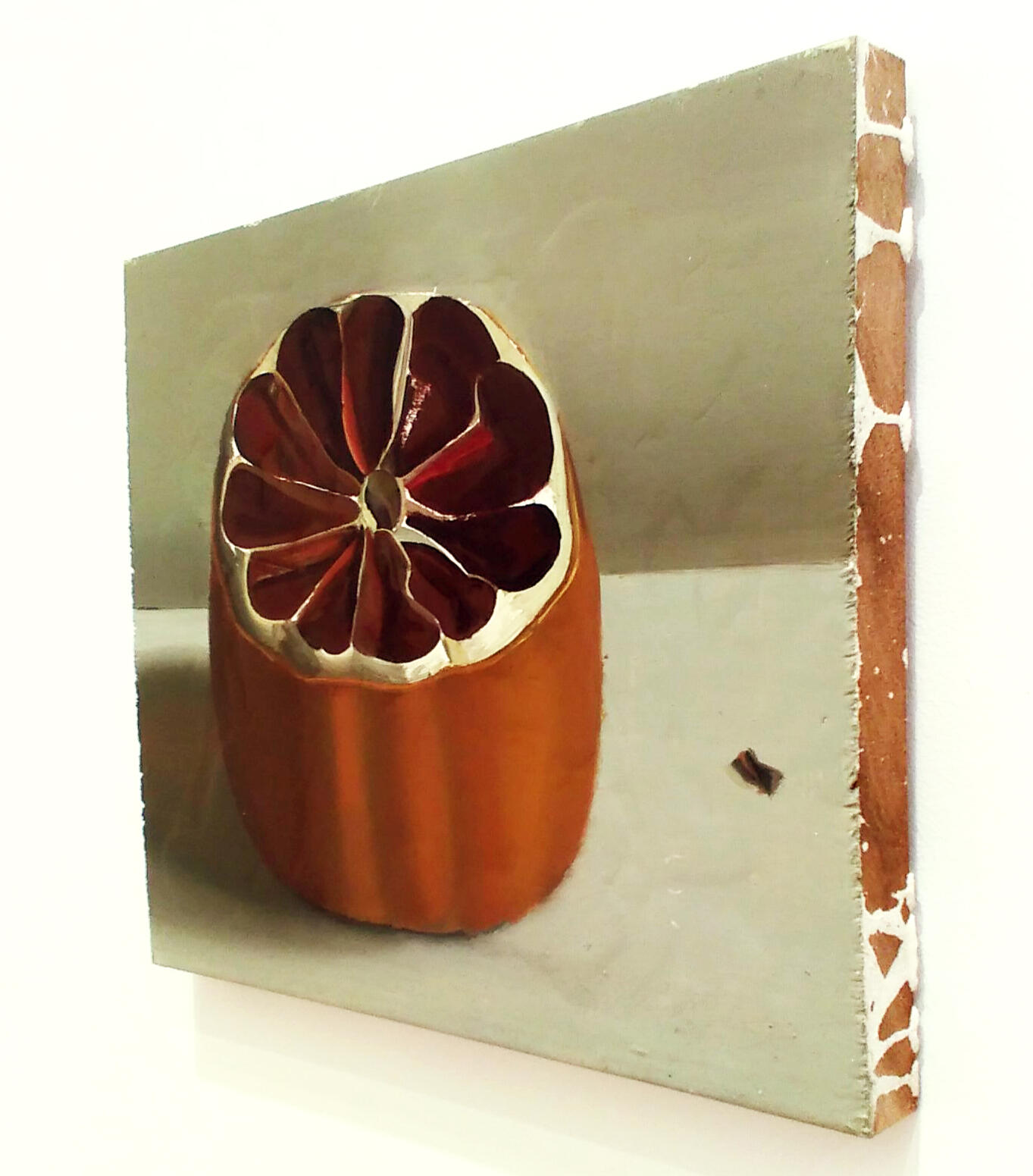
Phoebe Helander, Cross-Section of an Old Lemon II, 2025. Oil on wood, 11 1/4 × 13 inches.
This synthesis, however, happens in only a few of the paintings in the show. The many others land in the comfortable realm of alla prima still life—fine enough (for decoration). But the paintings claim to do more (or, rather, their maker claims they do in the show’s accompanying essay and press release): to bear witness to change and instability in a world that quantifies, sensationalizes, and advertises. But although painted in front of wilting bouquets and burning candles, flower and flame alike may well have been painted from photograph, so stable and unproblematic are Helander’s finished paintings. There is nothing inherently wrong with paintings that take on the quality of photographs. But we do not see like cameras. And Helander’s commitment to durational six- to ten-hour alla prima painting sessions of changing objects, to perception beyond the screen, more often than not results in photographic images, so that the process is only discoverable in her writing (by turning our attention away from the works to read an explanation of them):“So I end up continually painting over my work, re-making the same central area of the composition, for as long as the candle burns. Loss is a natural part of change, and that’s something I accept as a part of this work. My goal is to stay with the flame.”A nice idea. But paintings are ideas materialized. And the idea is not materialized in most paintings in the show.Paintings are static, visual objects. To materialize loss, a painting must contain what was before—it must reveal its own history visually. Such a commitment to durational attention as Helander’s, if it is to become art and not simply a token of her personal meditation (for what could we viewers learn from the latter?), must solve the formal problem of how to embody the phenomenological experience of an object that is three-dimensional and temporal by nature in the two-dimensional and static medium of paint. This problem was not solved, once and for all, with Cubism, or Futurism, or any other Modern -ism. It remains the problem of each painting today. How do we represent the world when we are habituated (addicted) to having screens and algorithms pre-process experience for us?Contrary to Helander’s “staying with the flame,” the kind of attention that is the antidote to the doomscrolling, ad-riddled, ADHD-inducing addiction of contemporary life is not the mere presentness of sense certainty, for which this-here-now is all there is and is gone as soon as it is. Such is the ahistorical presentness of the amnesiac. A productive presence of mind would rather be a type of attention that brings its past forward with it: a presentness with a historical consciousness that is aware that the material it encounters is informed by what happened before—whether the wax formations of a melting candle, a prior brushstroke by one’s own hand, or the historical genre of still-life painting—and is the ground from which the future develops. The real problem is how to cultivate presence of mind while committing to what came before and what comes after: a problem that painting alla prima may not be able to tackle with its limit of working only while the paint is wet. What happens when Helander commits to the same painting day after day? Month after month? The solution would perhaps not be so fresh, so nice, so many (so potentially profitable). I venture to think that such an undertaking might be appealing to Helander, given the values she articulates in her essay and her attraction to materials that change over time (pools of medium-rich paint that will wrinkle as they dry, warping supports that will crack the paint film).That most of Helander’s paintings don’t go beyond a way of seeing habituated to a pre-processed, flattened image taken by a mechanized cyclopic lens, is understandable given the nature of her undertaking. The formal-material problem she has set herself, which requires overcoming deep conventions of how we see today, is vast enough to devote a life to. The three or four paintings in the show that hint at a solution to the problem are promising steps for further inquiry. That the show at large doesn’t go beyond an Instagram-like glut of images, turning the three room gallery space into a kind of feed in which the viewer circumambulates instead of scrolling through images packed too close to each other, however, undercuts the project. The painter’s commitment to this problem would be more convincing had the forty-six or -seven other paintings been left out. The success of this project would entail that each painting asks a viewer to look at it with the same degree of effort and attention that was put into it—an impossible task in a space packed with fifty paintings and nowhere to sit.
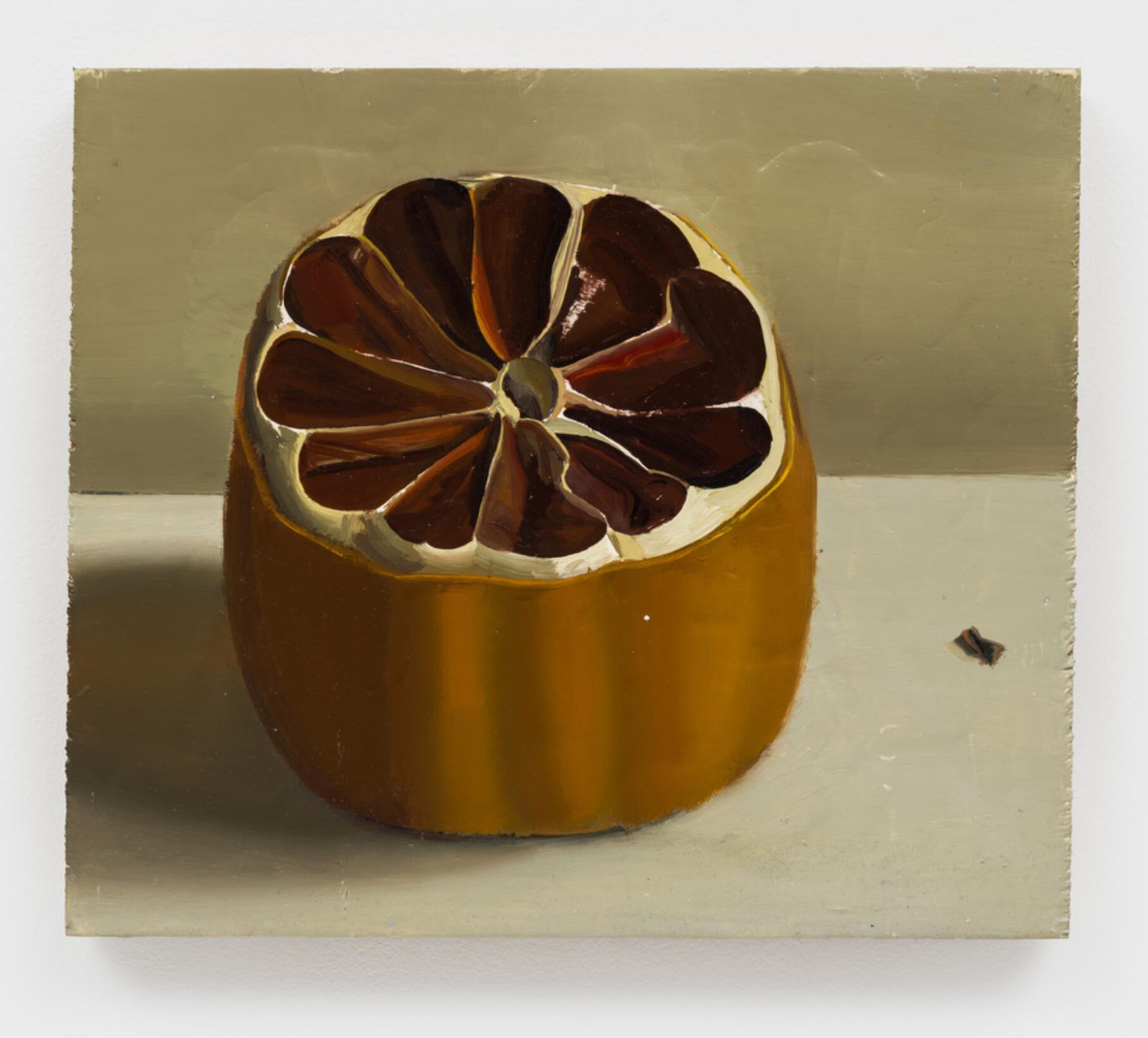
Phoebe Helander, Cross-Section of an Old Lemon II, 2025. Oil on wood, 11 1/4 × 13 inches.
Phoebe Helander, Paintings from the Orange Room, P·P·O·W, 390 Broadway, 2nd Floor, October 31 - December 20, 2025About the Author:
Anna Gregor is a painter who occasionally writes about Paintings. Her essays can be read in The Revenant Quarterly, Caesura, and Two Coats of Paint.

PERSEITY
art review
TITLE
ARTIST/EXHIBITION
DATE | by AUTHOR
ARTIST, TITLE, YEAR. MEDIUM, DIMENSIONS inches.
BODY TEXT
ARTIST, TITLE, YEAR. MEDIUM, DIMENSIONS inches.
ARTIST, EXHIBITION TITLE, GALLERY, ADDRESS, DATE.About the Author:
AUTHOR BLURB
Website

PERSEITY
art review
Homage To—
December 15, 2025 | by Arnold Klein
Peter Fuller somewhere recounts how his unconversion from what may be called the Acrid School of Marxist Art Criticism was effected by his encounter with an ancient sculpted head, whose power to move him he found wholly unrelated to the class struggle, means of production, false consciousness, late capitalism and all the rest.Well, I had a similar experience—though not of unconversion from an ideology but of confirmation to what I take to be a cardinal artistic value—up at the MOMA a few years ago when I turned the corner of a room containing the perfectly awful portrait of Condeleezza Rice by Luc Tuymans (and I name it, her and him for a reason) and came across—But before getting to exactly what I came across, let me say of the experience itself that it was characterized by the absence of what I usually find present in my visits to the art world and by the presence of what I usually find woefully absent there.What was absent in that experience that was usually present? Discourse: discourse contextual, biographical, art-historical, critical even, overt or implied; and all the cants respectively accompanying them—the whole logo-noetical sea into which, as Gilson says, everything disappears. (The Talmud is not wrong when it reminds us that the tongue is the only muscle that never gets tired.)What was present, that was usually absent—that obviated discourse, and rendered it impertinent in both senses—malapert in both senses?Imaginative expression.Expression has gotten a bad rap; it has been taken to mean something like unclarified and uncontrolled emotion. But I mean it as referring, in art, to any significant record of a sensory-motor-affective-intellectual experience, including, of course, the (sensory-motor-affective-intellectual) experience of coming to clarify that experience in a material form, that is, in a work; and I call it “imaginative” because it is only in some power that is neither sense, motor, feeling nor intellect only that those (and everything else coming into it) can form a unity and result simultaneously in a record of that unity, that is, in a work. I don’t mean to commit myself to a facultative theory of mind here, only to emphasize that, in expression, the whole person is at once the impetus and the site of a process, whose termination, in art, is a work.As must the whole person be engaged, in the reception of a work.Not the “effect:” effect implies passivity on the part of what is usually called the reader, the viewer, the audience, and so on; the-eye-goes-here-the-eye-goes-there sort of thing; the we-laughed-we-cried sort of thing; the what-did-the-poem-make-you-feel sort of thing. But reception is not passive—you make yourself receptive, you engage (in Captain Picard’s sense) what Pater called “the power of being deeply moved,” as paradoxical, even as oxymoronic as these formulations sound. Not every work put out as art, or putting itself out as such, calls for reception in this sense, the discourse-laden portrait of Rice certainly does not;—or answers your call, though more works than you might think will gladly do so, if asked (but not until then). As Lamb said of certain old books, and as we might say of certain cold people, some art works have to be loved before they will prove themselves worthy of love.So imaginative expression covers both sides, maker and recipient, as the recipient is remaking the expression of which the made thing is the significant record, from that record alone. You can call it communication if you want to, if you emphasize the commune part, the verbal stem, not the petrifying -ation, the noun, and even abstract noun, part, as two whole persons are indeed meeting; but not if you regard communication on the usual verbal model of one-party-telling-something-to-the-other, simply, and disregard the plain fact that the other in even the simplest case must take the words in, which is another way of saying make herself receptive, if communication is to take place at all. And not if you assume, again on the usual verbal model, that communication is always about something (the what-is-she-trying-to-tell-us sort of thing; the what-is-this-movie-really-about sort of thing), as there is no about in communion.So what was the work that confirmed my commitment to imaginative expression as a cardinal artistic value?You see my dilemma: no discourse allowed! But before I name it, and the name attached to it on the museum plaque, let me say something about this sad business of associating art works with the empirical persons usually taken to be their makers—the people who are born, live and die, eventually becoming fodder for biographers—instead of with I will call, following Croce, the aesthetic personage, knowable to us only through, and as, the physiognomy of the works themselves.As to the empirical person: it is not merely that most of the world’s greatest works are anonymous, actually anonymous; it is not merely that the materials for anybody’s life are fragmentary and variously interpretable, when in fact there are any such materials left (as there are not in Shakespeare’s case, among others); it is not merely that most of anybody’s life, and probably the most important part—the moment-to-moment contents of her consciousness—leaves no record, variously interpretable or otherwise; it is not merely that biography is a literary genre and no more to be credited as true than any other subclass of fiction, including history, nor that it follows pseudo-absolute interpretative fads (who swallows “psychobiography” anymore?); it is not merely, in sum, that people are unknowable, even to journalists. It is that the empirical person and the aesthetic personage are of completely different interests.A Nietzsche scholar quoted by Rorty (I don’t have the book to hand) says he is not interested in “the miserable little man who wrote Nietzsche’s books,” but in the character created in them; and here too, I am not interested in the by-all-accounts wonderful empirical person named on the plaque, but in the aesthetic physiognomy projected in the individually characteristic works that go about in the world under her name. Let’s get the order straight: the empirical person, even if we knew anything more than a few promiscuous superficialities about him or her, which we cannot (see above), would be of no interest whatsoever but for its misleading association with the artistic personage and its physiognomy, which we can know so profoundly.1And I might add, know directly. The empirical artist may be sheltering in Rossinière or drinking in Soho or moldering in Vauvenagues Castle or currently dust, but the works are right here, silently calling to us or silently waiting for our call to answer.But here’s the thing: not every work going by an artist’s name will originate in the aesthetic personage and manifest its characteristic physiognomy. The empirical person can still use a paintbrush, and other interests than purely artistic, i.e., imaginatively expressive, ones (rhetorical ones, for example) may direct her hand. Such works will go by the same name as the artistic ones, of course, and sell out of the same dealership and take up space in the same museum, though one would hope an expert institution like the MOMA could discriminate between the two, between what Croce called poesia e non poesia, between painting and not-painting, and not devote wall space to canvasses that have nothing expressive going for them beyond their nominal association with an artist, Luc Tuymans, and his subject, Condeleezza Rice, say.Once upon a time, at Fanelli’s, around one p.m., it was not uncommon for the conversation around not a few tables to turn to the question of “who was the greatest living painter,” and the debate (to date it somewhat) usually devolved into a contest between Balthus and Bacon and sometimes Mitchell, although one of the participants (initials R.L.) always and quite sincerely named himself. Well, convinced as I was that afternoon that whoever made Elephant with White Tusks was our greatest living artist (and no, I haven’t seen everything by everybody—but neither had the Fanelli’s painters, and that didn’t stop them), I set about trying to find other works by the same maker, and here knowing her name was very useful in hunting up a few images and a catalogue; but the one at the MOMA remains the only sculpture that I have seen in person.But at the risk of saying something, not so much about that sculpture as about why you should be interested in it: its chief expressive qualities are compassion and fragility; not compassion for fragility, for the fragility in question includes the compassionator no less than it does the piteous animal embodied in its burnt clay, and, indeed, through that, includes us all, human and animal—since all of us are, like clay, a little earth and a little water, fused for a little while by the fire of vital heat.I have a feeling that this, or something not far from this, is the physiognomic truth of the works that are going about in the world under the name of Daisy Youngblood.
1 And ditto for such curatorial concerns as “The Roots of Fauvism,” “Pioneers of Abstraction” and so on—we would have no interest whatsoever in the inchoate but for the perfections alleged to have developed from it. Matthew Arnold got it right when he warned that the “historical estimate of art” would divert attention to origins and away from the consummations that alone would give them such interest as they might possess. (For a lark, try searching "pioneers" in the MOMA database.)
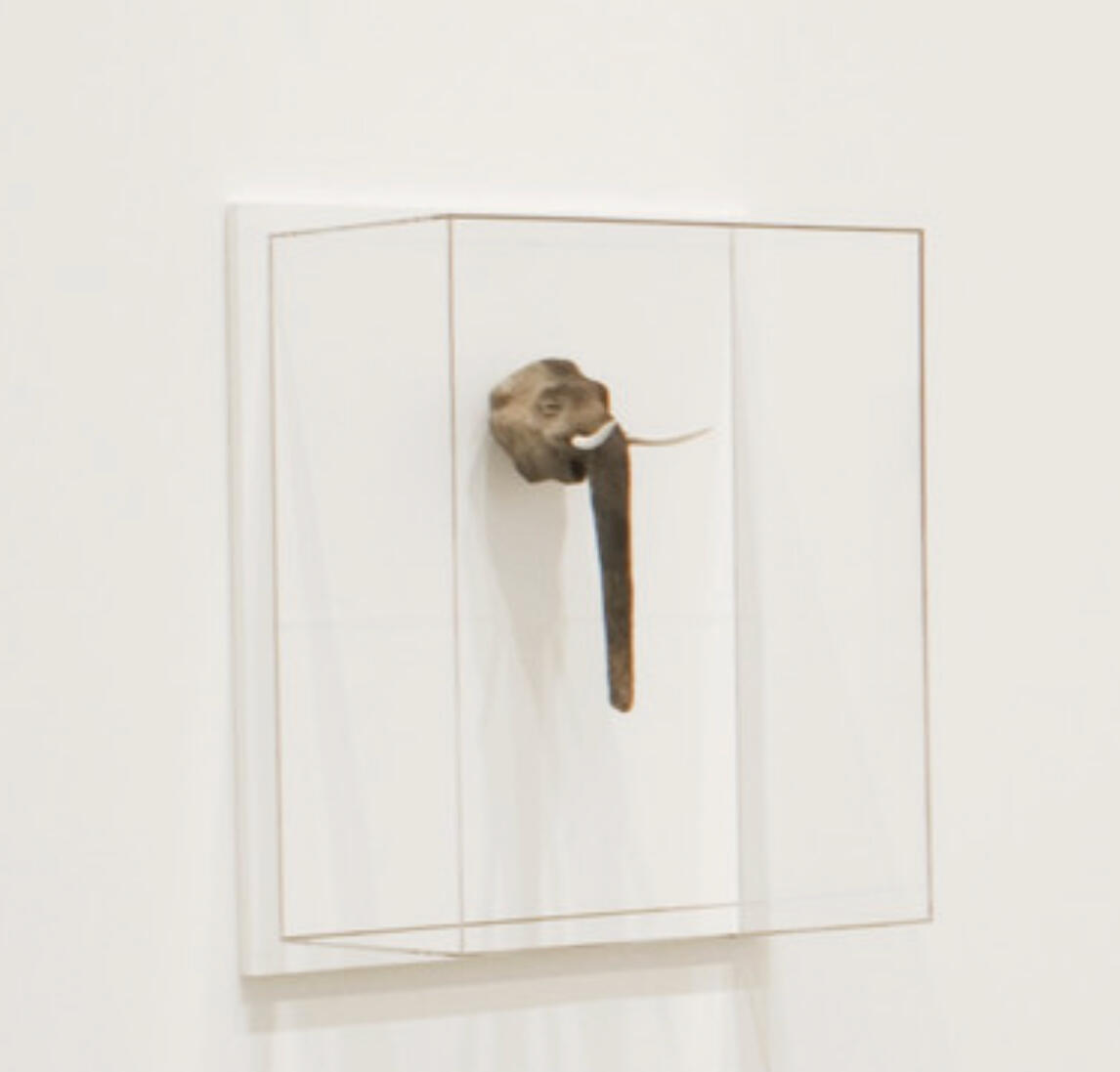
Daisy Youngblood, Elephant with Tusks, 1995. Low fire clay and paint, 18 1/4 x 14 1/2 x 5 1/2 inches.
About the Author:
Arnold Klein's work appears regularly in The Revenant Quarterly.

PERSEITY
art review
Virtuosic(-ish) and Vacuous: John Singer Sargent and Doron Langberg | by Candice T. Seymour | December 13, 2025
Langberg, Doron
Virtuosic(-ish) and Vacuous: John Singer Sargent and Doron Langberg | by Candice T. Seymour | December 13, 2025
Sargent, John Singer
Virtuosic(-ish) and Vacuous: John Singer Sargent and Doron Langberg | by Candice T. Seymour | December 13, 2025
Seymour, Candice T.
Virtuosic(-ish) and Vacuous: John Singer Sargent and Doron Langberg | by Candice T. Seymour | December 13, 2025
Virtuousic(-ish) and Vacuous
John Singer Sargent and Doron Langberg
December 13, 2025 | by Candice T. Seymour
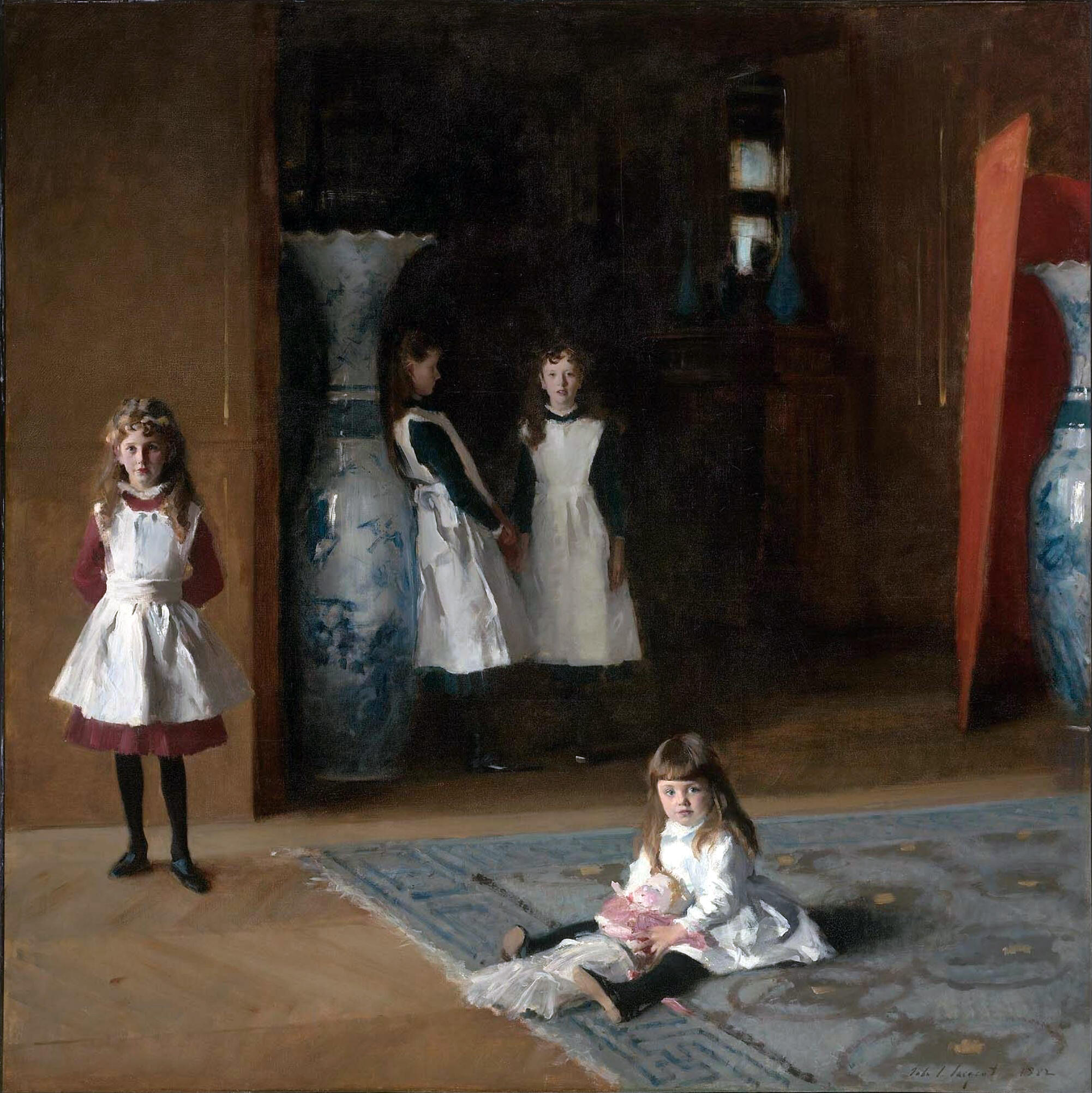
John Singer Sargent, The Daughters of Edward Darley Boit, 1882. Oil on canvas, 87 3/8 × 87 5/8 inches.
There is something off-putting about the paintings of John Singer Sargent. Mention him to a painter and they're certain to remark on his virtuosic paint handling, the luminosity of his lights, his ability to capture his sitter’s countenance… But they are just as certain to, in their next breath, mumble something about not caring very much for his work. A noteworthy admittance, given that painters are generally suckers for “painterliness” (particularly in an age, like ours, when a decades-long dearth of technical skill has boomeranged into material fetishism). This is not to suggest that professional paint pushers are right in their judgments of paintings (usually they are not), but it is a convenient fact for this author who, after visiting the Metropolitan’s recent Sargent in Paris exhibition, was convinced of the paintings’ utter vacuity—and this despite Sargent’s apparent “virtuosity.”It is difficult to put one’s finger on what’s off. There is something a little lechy in Sargent’s gaze, not unlike the attention paid to girls by their older cousins: icky but probably not dangerous. But this is not enough to make a painting bad. There are many creepier, infinitely better paintings by Balthus. There is something tasteless in the displays of wealth in his depictions of his bourgeois clientele. But Velasquez’s paintings of kings and aristocrats retain their profundity, which suggests that the ostentation alone can't be the cause. Most interestingly, there is something that reminds one of images generated by AI, something beyond the performative brushiness of a digital paintbrush. One is tempted to claim: Sargent’s paintings lack soul. But (though right) such an articulation is not productive for criticism. The “soul” they lack is not that of the empirical person, John Singer Sargent, nor that of his sitters. (Lest we forget, misled by biopics and wall plaques, the empirical people behind a work are irrelevant to it.) The paintings themselves lack a soul, that special animation of an artwork that defines itself.
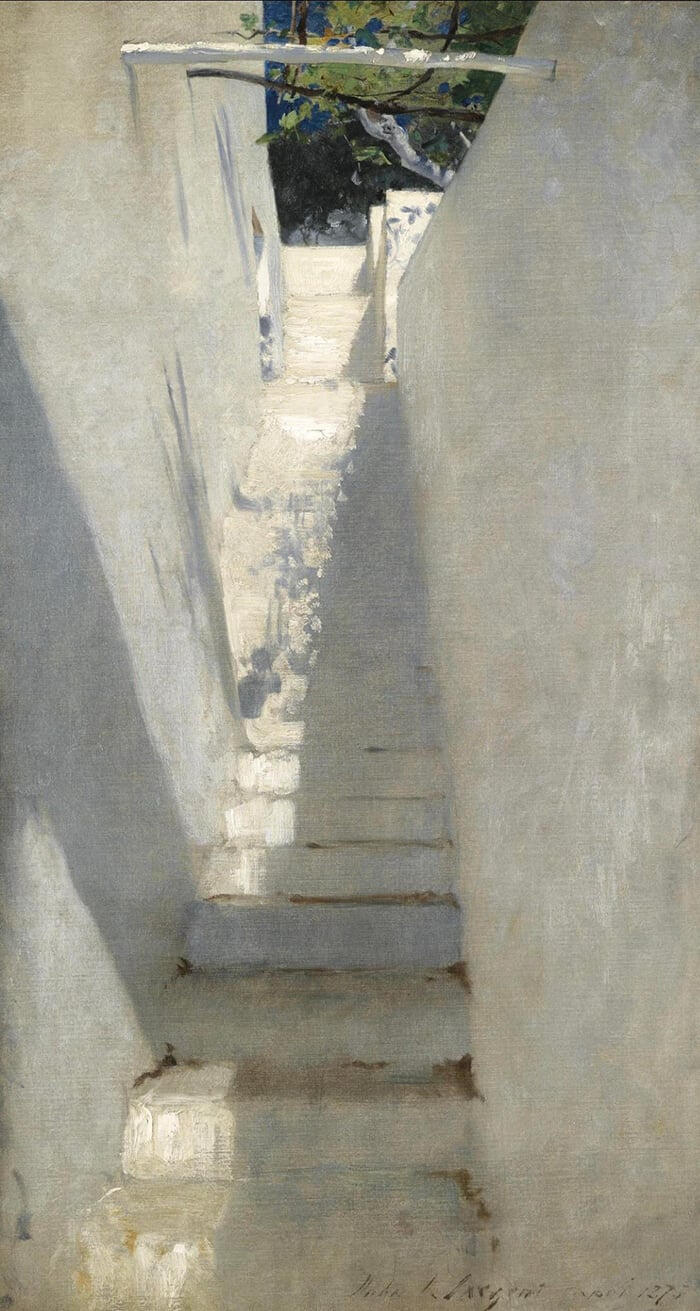
John Singer Sargent, Staircase in Capri, 1878. Oil on canvas, 32 × 18 inches.
They are soulless because Sargent was unfaithful to them, though his wayward desire was not for his sitters, but for their money. Doubtless, his clients patronised him because of his manual skills, best exemplified in Staircase in Capri, where the lilting brushstrokes transform the flat rectangle of the toned linen into the deep space of a rising staircase, as if by magic. They must have drooled over his ability to transform raw paint into depiction and, money in hand, commanded, “Make me such a thing!” And so he, rather than treating each painting as a problem to be solved, the solutions of which, concurrant with its form, would have been its very significance; rather than finding a new problem for each painting of each sitter, Sargent reached for a canned problem: the generic problem of luscious paint becoming represented thing. As in the portrait of Marie Buloz Pailleron, he’d sketch in a cloying background behind his subject, within which he would paint a flower over here, a flower over there, then—voila!—a glob of paint next to them, as if to say, “Look at the magic of paint! Look at the virtuosity of John Singer Sargent!” Canned problem, unreal solution. Hence, the emptiness that recalls images generated by Dall-e. In the paintings in which he seems to have tried for something deeper, as in The Daughters of Edward Darley Boit, he gropes for significance on the wrong plane: that of symbolic meaning, the kind of meaning that Adorno calls thematic, which goes extinct with time as conventions change. Baby girl with a baby doll, young girl, pre-teen girls, giant vases prefiguring the rounded shape of pregnancy: one can get no further with this painting than the empty idea of motherhood looming over the girls’ futures. Only what is more than merely thematic content persists, and already, a mere 150 years later, this painting is substance-less. What appeared as virtuosic fades into cliché.This brings us to Doron Langberg’s Lovers at Night, just a few galleries and a flight of stairs away. The painting of the lovers, like Sargent’s paintings, pretends to the problem of paint becoming depiction. Also like Sargent’s paintings, it at first appears virtuosic(-ish). But the painting of the two lying figures, composed of performative brushstrokes with neon underpainting peeping through, their bodies nearly dissolved into abstraction, reveals itself to be substanceless. Its rhetorical meaning is clear: the act of painting (playing with variously-colored, luscious liquids and semi-solids) is analogous to the acts of eros undertaken in bed by lovers. In acts of love, two bodies dissolve into one; in art, the viewer, likewise, loses themselves in pleasure by luxuriating in the materiality of the painting. Art, like love, is hedonistic: pleasure, like art, is the highest achievement of humankind. This would all be well and good if the painting achieved this, but it remains on the plane of thematic content, mere syllogism rather than significant solution to a problem in paint. Although the paint that composes and surrounds the two lovers at first appears luscious, the closer one looks, the more contrived the image, the more stingy the paint’s application, the more performative the brushstrokes. Less does it seem that the figures came to be at once with the whirlwind of paint manipulation, more does it seem an academic sketch of figures, stylistically unfinished because the artist, much like the average adolescent pencil-wielder, doesn’t want to labor over digits or members. Allegedly a homoerotic encounter, only one of the figures is identifiably male, so even the “subversive” content is undefined, present in word only. Like the verdict on Sargent’s works, one might say that this thematic content has perished with age. But since the painting was made less than two years ago, it’s more likely that it was empty the day it was made.
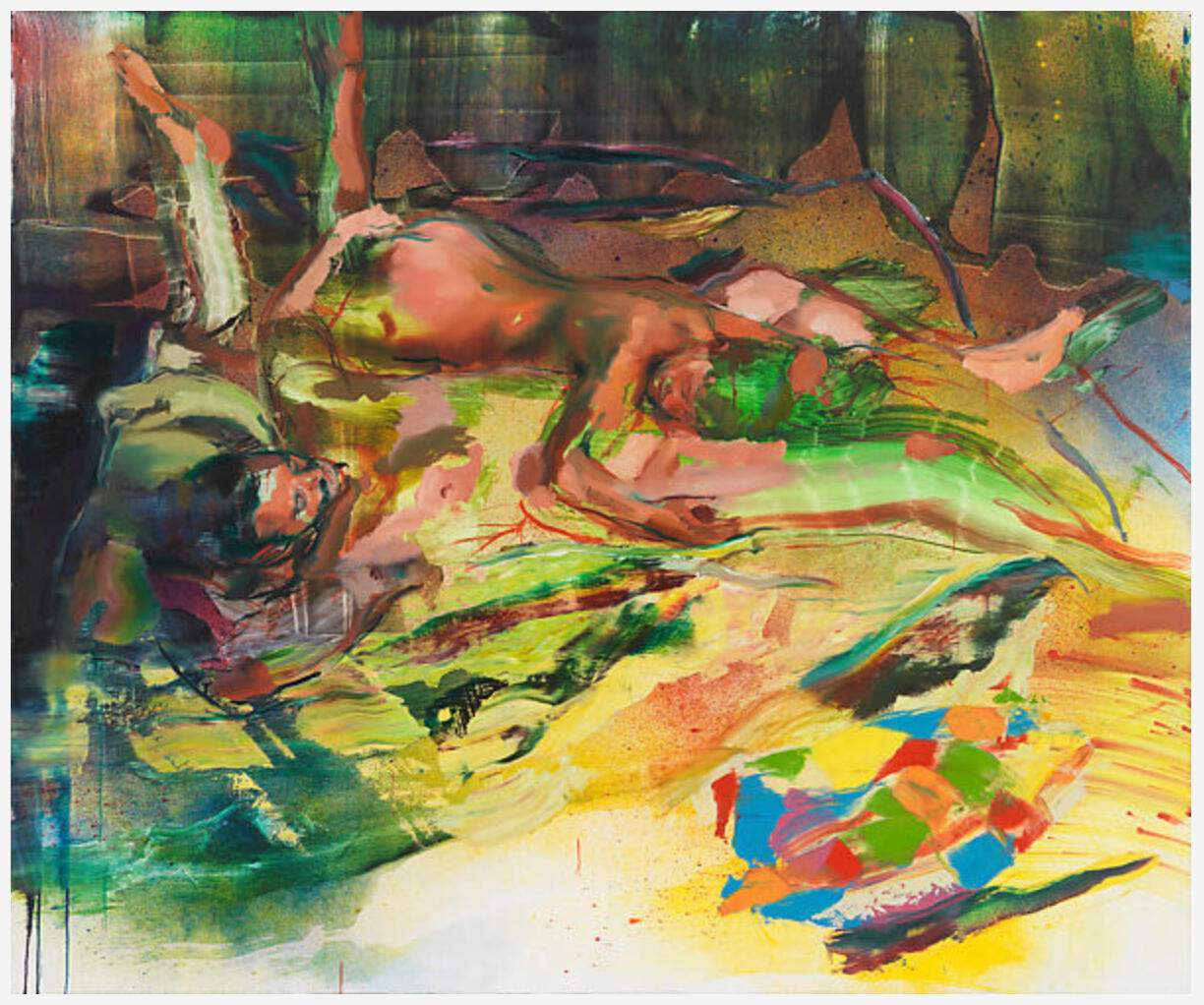
Doron Langberg, Lovers at Night, 2023. Oil on linen, 80 x 96 inches.
About the Author:
Candice T. Seymour loves good artworks, is tired of mediocrity, suspects most artists don’t even like art, and hates nihilistic “critics”.
Substack

PERSEITY
art review
Contributors
Bayless-Hall, Eric
Reflections from a Dead End: Flora Yukhnovich’s Four Seasons at The Frick | February 19, 2026
Perception and the Essay of Criticism | December 15, 2025
Elliott, Emmet
Le Repas Frugal | January 5, 2026
Gregor, Anna
Alla Prima Amnesia: Phoebe Helander at P·P·O·W | December 15, 2025
Klein, Arnold
A Sense as Cold... | February 9, 2026
Homage To— | December 15, 2025
Seymour, Candice T.
The Consolation of Illustration: Dana Schutz | January 18, 2026

PERSEITY
art review
Artists
Helander, Phoebe
Alla Prima Amnesia: Phoebe Helander at P·P·O·W | by Anna Gregor | December 13, 2025
Picasso, Pablo
Le Repas Frugal | by Emmet Elliott | January 6, 2026
Schutz, Dana
The Consolation of Illustration: Dana Schutz | by Candice T. Seymour | January 17, 2026
Shakespeare, William
A Sense as Cold... | by Arnold Klein | February 9, 2026
Youngblood, Daisy
Homage To— | by Arnold Klein | December 13, 2025
Yukhnovich, Flora
Reflections from a Dead End: Flora Yukhnovich’s Four Seasons at The Frick | by Eric Bayless-Hall |
February 19, 2026

PERSEITY
art review
Contact
Essay Submission Suggestions
Reviews / essays can be submitted for consideration using our Submissions Form. Some DON’Ts:
- AI
- Press release regurgitation
- Free association
- Uncritical "criticism" Some DOs:
- Deal with individual artworks
- Look hard, write hard
- Play (rigorously) with the essay form
- Make judgments
